
Gaining relevant, useful knowledge and applying it helps us build confidence to navigate the world around us in a bold way. Either it be career or personal life, knowledge is required to perform one’s duties and contribute better toward society as a whole. One such branch of knowledge is Mathematics
Mathematics or Maths is the branch of knowledge that deals with numbers, quantities, shapes, patterns and logical arrangements or relationships.
It helps us to make sense of the world using calculations and reasoning.
Attempt a simple quiz below to know whether you have understood the meaning of Maths
Mathematics Concept Quiz
Interesting Maths Facts
Here are some interesting facts about Maths:
- Zero was discovered in India
The concept of zero was developed by Indian mathematicians. Without zero, modern mathematics and computers would not be possible. - The word “Mathematics” comes from Greek
It comes from the Greek word mathema, which means “knowledge” or “learning.” - Every even number greater than 2 may be written as the sum of two prime numbers
Example:
10 = 5 + 5
20 = 7 + 13
This is called Goldbach’s Conjecture, but it has not been fully proved yet. - Pi never ends
The value of π is approximately 3.14, but its decimal digits go on forever without repeating. - A circle has infinite lines of symmetry
No matter how you divide a circle through its centre, both parts are equal. - The number 9 has a magical property
If you multiply 9 by any number and add the digits of the answer, the result often comes back to 9.
Example:
9 × 7 = 63
6 + 3 = 9 - One is not a prime number
A prime number has exactly two factors: 1 and itself.
Since 1 has only one factor, it is not prime. - Maths is used in nature
Patterns like honeycombs, flowers, shells, leaves, and even pineapples follow mathematical patterns. - There is no Roman numeral for zero
Ancient Romans did not have a symbol for zero in their number system. - The Fibonacci sequence appears in nature
The sequence 1, 1, 2, 3, 5, 8, 13… appears in sunflower seeds, pine cones, shells, and flower petals. - A triangle is the strongest shape
Triangles are used in bridges, towers, and buildings because they are very stable. - Maths helps improve logical thinking
Solving maths problems trains the brain to think step by step and find solutions. - The equals sign was invented in 1557
It was introduced because writing “is equal to” again and again was too long. - Every number has a square, but not every number has a perfect square root
Example:
5² = 25, but √5 is not a whole number. - Maths is the language of science
Physics, chemistry, astronomy, engineering, coding, architecture, and economics all use mathematics.
Introductory Video on Maths
Below is an introductory video on Maths. Watch it to know where it is used and broad topics in Maths
Why learning Maths is important?
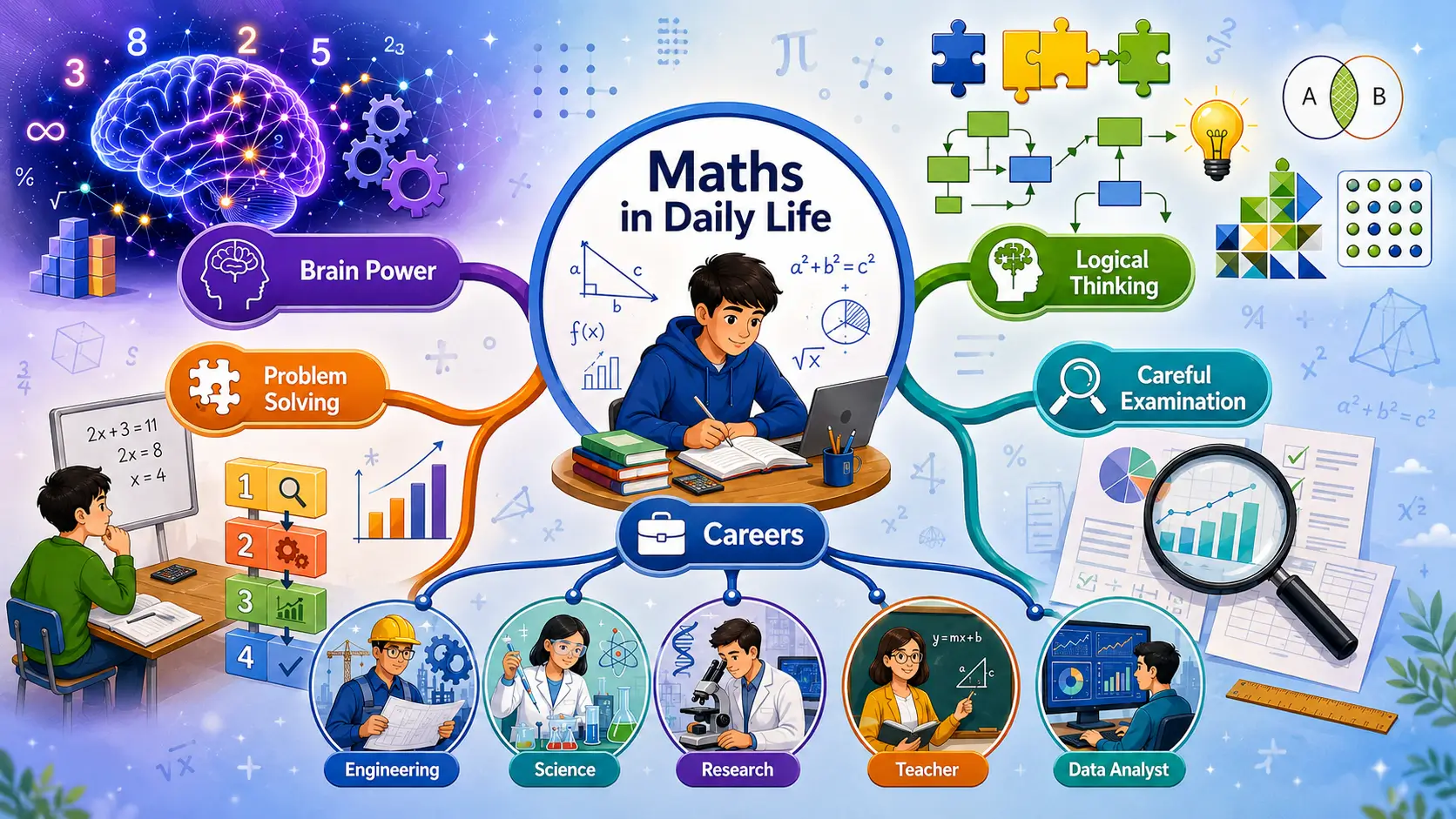
Imagine going to a grocery store and there is a balance amount to be paid by store owner and you don’t know arithmetic of what needs to be paid by him ! Cringe situation, right?
Learning and applying Maths in daily life improves brain power and helps make intellect sharp as it helps develop logical thinking, improve problem solving skills and also the ability to use careful examination in order to understand or explain something. This skill is also essential in careers, to name a few, like engineering, science, research, teacher, data analyst.
Attempt the quiz below to know if you have properly understood the importance and benefits of learning Mathematics:
Benefits of Learning Maths Quiz
Main Topics and Sub-Topics in Maths
Mainly Maths includes Numbers, Arithmetic, Algebra, Geometry, Mensuration, Trigonometry, Calculus, Statistics, Probability, Set theory, Coordinate Geometry, Combinatorics.
Watch the below video to know main topics under Maths and sub topics under the main topics.
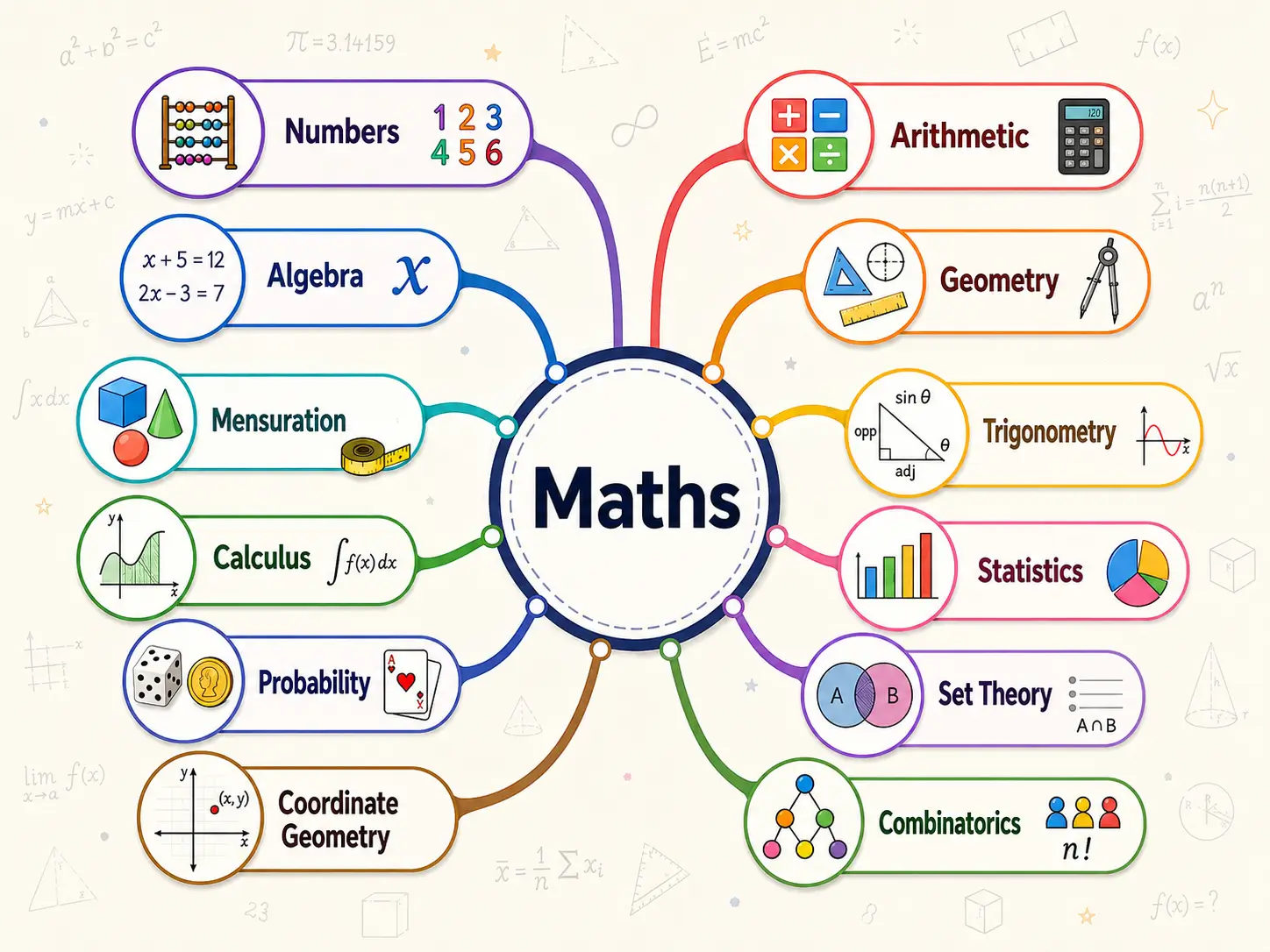
Maths includes different topics which help us understand quantities, shapes, relationships, and problem-solving in both academic and real-life situations. Given below are names of topics with sub topics in Maths.
Numbers in Maths
Numbers are mathematical representations used for counting, measuring, and labeling objects.
Advertisements
Types of numbers are :
- Natural Numbers
- Whole Numbers
- Integers
- Rational Numbers
- Irrational Numbers
- Real Numbers
- Complex Numbers
- Even and Odd Numbers
- Prime and Composite Numbers
Other topics:
Arithmetic
Arithmetic is the branch of mathematics that deals with basic operations on numbers such as addition, subtraction, multiplication, and division.
Subtopics under Arithmetic include:
- Addition
- Subtraction
- Multiplication
- Division
- Fractions
- Decimals
- Percentages
- Ratio and Proportion
- Average
- Profit and Loss
- Simple Interest
- Compound Interest
- Speed, Time, and Distance
- Time and Work
- HCF (Highest Common Factor)
- LCM (Lowest Common Multiple)
Algebra
Algebra is the study of mathematical symbols and variables used to represent relationships and solve equations.
Subtopics under Algebra are:
- Variables and Constants
- Algebraic Expressions
- Exponents and Powers
- Terms and Coefficients
- Linear Equations
- Quadratic Equations
- Polynomials
- Factorization
- Algebraic Identities
- Inequalities
- Functions
- Graphs of Equations
Geometry
Geometry is the field concerned with the study of shapes, sizes, angles, and spatial properties of figures.
Subtopics of Geometry are:
- Point, Line, Line Segment
- Ray
- Angles
- Types of Angles
- Parallel and Perpendicular Lines
- Triangles
- Quadrilaterals
- Circles
- Polygons
- Symmetry
- Coordinate Geometry
Mensuration
Mensuration is the area of maths that focuses on measuring the length, area, surface area, and volume of geometric figures.
Subtopics of Mensuration are:
- Perimeter
- Area
- Surface Area
- Volume
- Area of Triangle
- Area of Circle
- Volume of Cube
- Volume of Cuboid
- Volume of Cylinder
- Volume of Cone
- Volume of Sphere
Trigonometry
Trigonometry studies the relationships between angles and sides of triangles.
Subtopics under Trigonometry are :
- Trigonometric Ratios (sin, cos, tan, etc.)
- Trigonometric Identities
- Trigonometric Functions
- Trigonometric Equations
- Inverse Trigonometric Functions
- Inverse Trigonometric Equations
- Applications of Trigonometry
- Angles
- Unit Circle
- Heights and Distances
Calculus
Calculus deals with rates of change and the accumulation of quantities.
Subtopics of Calculus are:
- Limits in Calculus
- Continuity
- Differentiability
- Differential Calculus
- Differentiation
- Integral Caclulus
- Derivatives
- Applications of Derivatives
- Integration
- Definite Integrals
- Indefinite Integrals
- Application of Integrals
Statistics
Statistics is the branch of mathematics that deals with collecting, organizing, analysing, and interpreting data.
Subtopics under Statistics are :
- Descriptive Statistics
- Data Handling
- Measures of Central Tendency
- Inferential Statistics
- Sampling Methods
- Descriptive vs Inferential Statistics
- Measures of Dispersion
Probability
Probability studies the likelihood or chance of events occurring.
Subtopics of Probability are:
- Basic Concepts of Probability
- Probability Theory
- Conditional Probability
- Bayes Theorem
- Random Variable
- Probability Distribution
- Joint, Marginal, and Conditional Distributions
Set Theory
Set theory studies the collections of objects called sets and their relationships.
Subtopics of set theory are:
- Set Notation
- Types Of Sets
- Subsets
- Set Operations
- Venn Diagrams
- Power Set
Coordinate Geometry
Coordinate geometry is the study of geometric figures using a coordinate system to represent points and equations.
Subtopics under Coordinate Geometry are:
- Points, Lines, and Planes
- Coordinate Axes and Plane
- Cartesian Coordinate System
- X and Y Intercept
- Distance Formula
- Section Formula
- Midpoint Formula
- Conic Section
Combinatorics
Combinatorics is the study of counting, arranging, and selecting objects according to specific rules.
Subtopics under combinatorics are:
- Fundamental Principle of Counting
- Permutations
- Combinations
- Difference between Permutations and Combinations
- Pigeonhole Principle
- Inclusion-Exclusion Principle
Attempt the Quiz below to test your knowledge of different topics under Maths:
Topics in Mathematics Quiz
Maths is an essential subject that helps us understand numbers, shapes, and patterns. It is used in daily life, education, science, and technology. From simple counting to advanced engineering, maths plays a vital role everywhere.
Learning maths improves logical thinking, problem-solving skills, and analytical ability. It is one of the most important subjects for students and professionals.