


Before we dive deep into HCF(Highest Common Factor), we need to know the meaning of term factor.
Factors are numbers that we multiply together to get another number, for example:
2✖️3 = 6
Here numbers 2 and 3 are factors of number 6
Another example we can take is number 12
1✖️12 = 12
2✖️6 = 12
3✖️4 = 12
Means, 1, 2, 3, 4, 6, 12 are factors of 12
Can the factors of a number be negative? According to definition of factors, if the numbers being multiplied together give the number of which we are finding factors, then these numbers are factors of that number. Factors can be negative as multiplying two negative numbers gives a positive number
So, all factors of number 12 are: 1, 2, 3, 4, 6, 12, -1, -2, -3, -4, -6, -12
Depending on the context of the math problem, factors can be whole numbers(positive, negative) or fractions
In elementary arithmetic, factors are strictly limited to whole numbers. If fractions were allowed here, every number would have an infinite number of factors, making the concept useless for finding things like Highest Common Factor (HCF).
In algebra and calculus, factors can be fractions.
When teachers ask for the factors of a number like 12, they mean whole numbers that divide into 12 without a remainder, that is, 1, 2, 3, 4, 6, 12.
Common Factors
Suppose we need to find the factors of 12 and 30
Factors of 12 are 1, 2, 3, 4, 6 and 12
Factors of 30 are 1, 2, 3, 5, 6, 10, 15 and 30
As we can see, common factors, that is, the numbers which appear in both of factors of 12 and 30 are 1, 2, 3, 4, 6
HCF or GCF(Greatest Common Factor)
HCF is the greatest of the common factors that we find.
For 12 and 30 as we discussed above, the greatest of 1, 2, 3, 4, 6 is 6
So, the HCF of 12 and 30 is 6
6 is the greatest number that divides all the given numbers, that is, 12 and 30 exactly.
So, we can say GCF is the greatest number that divides all the given numbers exactly.
The above method of finding HCF or GCF is called Listing Factors Method
Methods of Finding HCF
1. Prime Factorisation Method
In this method, we express each number as a product of prime factors and multiply the common prime factors with their smallest powers to get the HCF
Example: Find the HCF of 24 and 36.
24 = 2 × 2 × 2 × 3
36 = 2 × 2 × 3 × 3
Common prime factors = 2 × 2 × 3
HCF = 12
2. Division Method
In this method, we divide the larger number by the smaller number. Then we divide the divisor by the remainder. We continue until the remainder becomes zero. The last divisor is the HCF.
Example: Find the HCF of 48 and 18.
48 ÷ 18 gives remainder 12
18 ÷ 12 gives remainder 6
12 ÷ 6 gives remainder 0
Therefore, HCF = 6
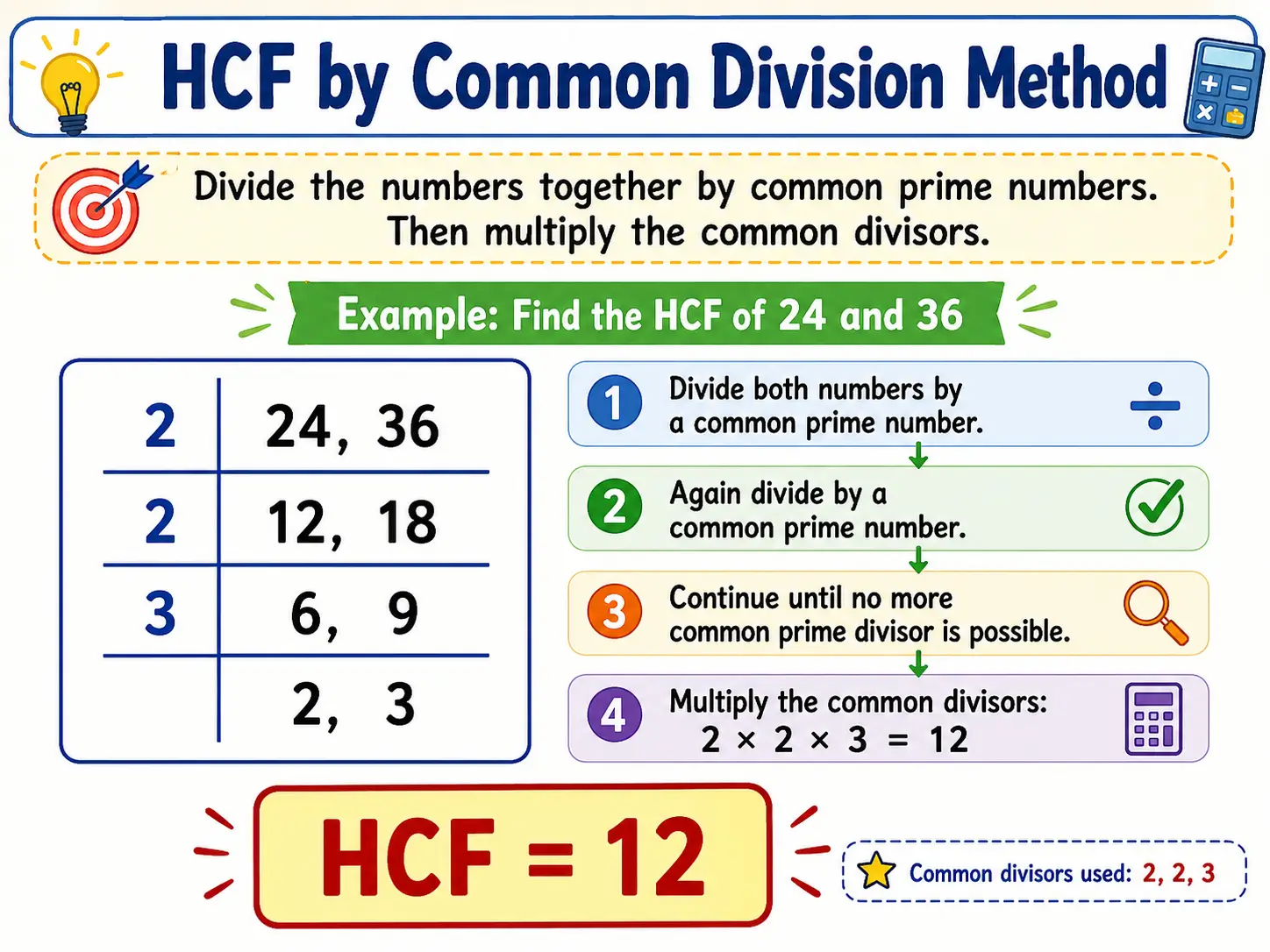
3. Common Division Method
In this method we divide all the given numbers together by common prime numbers and then multiply all the common divisors to get the HCF
Common divisors = 2 × 2 × 3
HCF = 12
4. Repeated Subtraction Method
In this method, we subtract the smaller number from the larger number repeatedly until both numbers become equal. The equal number is the HCF.
Example: Find the HCF of 18 and 12.
18 − 12 = 6
12 − 6 = 6
Both numbers are now 6.
HCF = 6
For Small numbers, Listing factors method can be used
For Numbers with easy prime factors, Prime factorisation method can be used
For Large numbers, Division method can be used
For Three or more numbers Common division method can be used
Interesting facts about HCF
- HCF means Highest Common Factor.
- It is the greatest number that divides two or more numbers exactly.
- HCF is also called GCD.
- GCD means Greatest Common Divisor.
- The HCF of two consecutive numbers is always 1.
- Example: HCF of 8 and 9 = 1.
- The HCF of two prime numbers is usually 1.
- Example: HCF of 5 and 7 = 1.
- If one number divides the other exactly, the smaller number is the HCF.
- Example: HCF of 6 and 18 = 6.
- The HCF of any number and 1 is always 1.
- Example: HCF of 25 and 1 = 1.
- The HCF can never be greater than the smallest given number.
- Example: In 12 and 20, the HCF cannot be more than 12.
- Two numbers having HCF 1 are called co-prime numbers.
- Example: 8 and 15 are co-prime numbers.
- HCF helps us divide objects into the largest equal groups.
- Example: It can be used to arrange chocolates or students into equal groups.
-
HCF is useful for simplifying fractions.
We divide the numerator and denominator by their HCF to write the fraction in its simplest form.
12 18 = 12 ÷ 6 18 ÷ 6 = 2 3The HCF of 12 and 18 is 6. Therefore, both the numerator and denominator are divided by 6.
11. For two positive integers, HCF × LCM = Product of the numbers.
For three or more numbers, the above relation is not always true
Proof: HCF × LCM = Product of Two Numbers
Let the two positive integers be A and B.
Suppose the prime factors occurring in the two numbers are p1, p2, p3, …, pk.
The prime factorisations of the numbers can be written as:
Here, the exponents may also be zero. If a prime factor is not present in one number, its exponent in that number is taken as zero.
Step 1: Write the HCF
In the HCF, we take the smaller power of each prime factor.
Step 2: Write the LCM
In the LCM, we take the greater power of each prime factor.
Step 3: Multiply the HCF and LCM
When powers having the same base are multiplied, their exponents are added.
Therefore,
How does the next step come?
For every prime factor, one exponent is smaller and the other exponent is greater. Therefore, adding the smaller exponent and the greater exponent gives the sum of the two original exponents.
For example, if the two exponents are 2 and 5, the smaller exponent is 2 and the greater exponent is 5. Therefore:
Hence, the previous expression becomes:
Step 4: Separate the powers
Using the law:
We get:
The first bracket is the prime factorisation of A, and the second bracket is the prime factorisation of B.
HCF × LCM = Product of the two numbers
Hence proved.
Example: 12 and 18
For the prime factor 2, the smaller power is 1 and the greater power is 2.
For the prime factor 3, the smaller power is 1 and the greater power is 2.
2 × 12 = 4 × 6 = 24.
12. The division method is one of the fastest methods for finding the HCF of large numbers.