
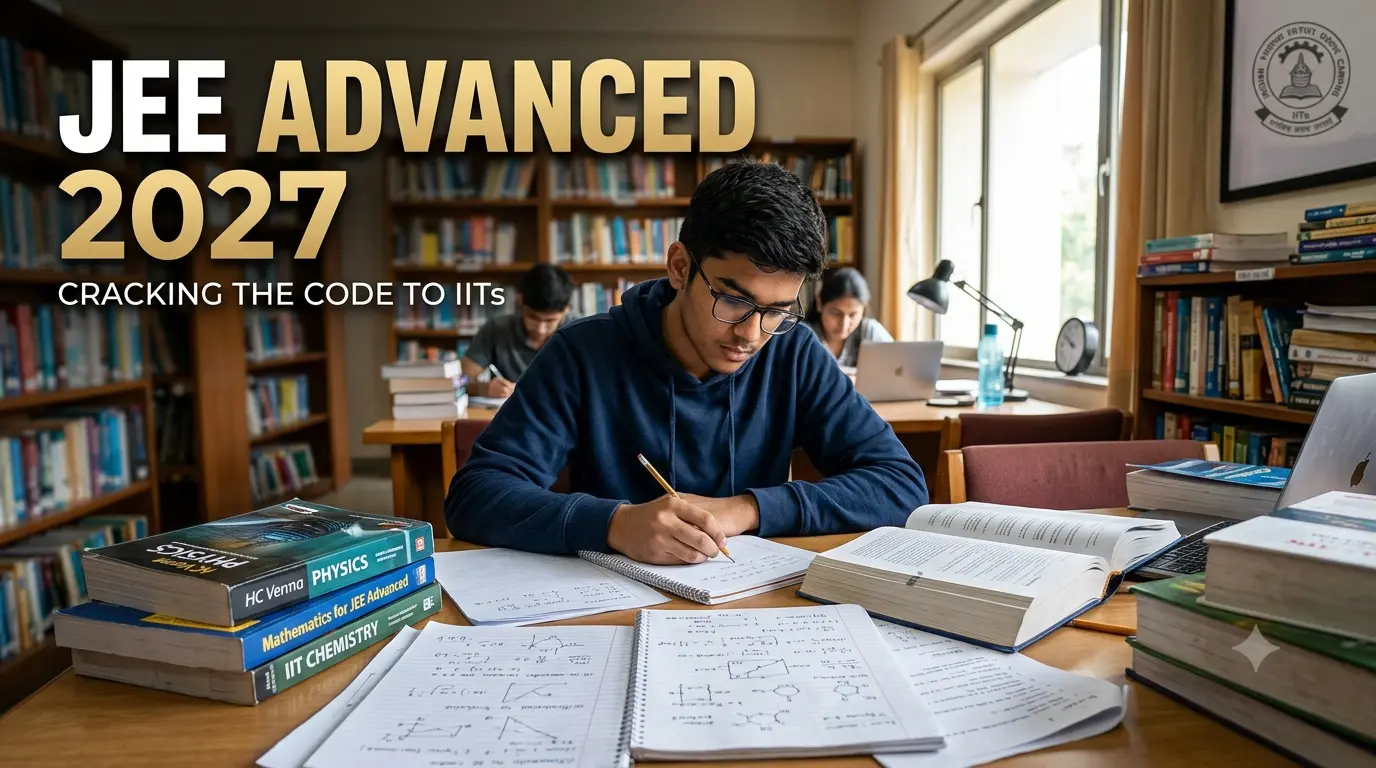

Cracking the Joint Entrance Examination (JEE) Advanced, requires more than just mastering complex concepts. It requires a deep understanding of its highly unpredictable exam structure. Expected to be organized by IIT Delhi, the JEE Advanced 2027 exam pattern will follow the old traditional way of testing analytical, application skills and time management.
JEE Advanced Core Structure & Timeline
The exam follows a two-paper format conducted on the same day. Attempting both papers is compulsory, as absence from either Paper 1 or Paper 2 renders a candidate ineligible for a rank.
| Parameter | Details |
| Exam Mode | Computer-Based Test (CBT) |
| Languages | English and Hindi |
| Papers | Paper 1 (Morning Shift) & Paper 2 (Afternoon Shift) |
| Duration | 3 hours per paper (6 hours total) |
| Total Marks | Typically 360 marks (180 marks per paper), though the IITs reserve the right to change this dynamically. |
JEE advanced 2027 syllabus
Success in JEE Advanced 2027 begins with understanding the nature of its syllabus. Unlike JEE Main, which has seen several chapters removed in recent years to reduce the academic burden on students, JEE Advanced continues to follow a broad and comprehensive syllabus.
The exam focuses not just on theory, but also on conceptual clarity, analytical thinking, and the ability to apply knowledge to challenging problems. As a result, many topics that may receive less emphasis in JEE Main or board examinations remain important for JEE Advanced preparation.
The key takeaway for 2027 aspirants is simple: do not limit your preparation to the reduced JEE Main syllabus or NCERT textbook coverage. JEE Advanced often tests deeper concepts, advanced applications, and experimental understanding that go beyond standard board-level requirements.
Physics: Testing Concepts and Application
Physics in JEE Advanced emphasizes conceptual understanding and problem-solving rather than direct formula-based questions.
- Major Topics: Mechanics, including Rotational Motion, Gravitation, and Fluid Mechanics, forms the backbone of the syllabus and contributes a significant share of questions.
- Important Areas: Electricity and Magnetism, Thermodynamics, Heat, and Modern Physics are frequently tested and carry substantial weight.
- Experimental Skills: Students should also prepare for questions related to laboratory experiments, measurement errors, vernier calipers, screw gauges, and data interpretation.
Chemistry: Equal Focus Across All Branches
Chemistry is divided into three sections, each requiring a different approach and an equal level of preparation.
- Physical Chemistry: Focuses on numerical problem-solving and includes topics such as Chemical Equilibrium, Electrochemistry, Thermodynamics, and Chemical Kinetics.
- Organic Chemistry: Tests reaction mechanisms and conceptual understanding through topics such as General Organic Chemistry, Stereochemistry, Hydrocarbons, and Biomolecules.
- Inorganic Chemistry: Emphasizes chemical bonding, coordination compounds, periodic trends, and qualitative analysis, with a growing focus on conceptual reasoning rather than rote learning.
Mathematics: Speed, Accuracy, and Logic
Mathematics in JEE Advanced demands strong analytical skills and precise calculations.
- Most Important Topic: Calculus remains the most influential area, covering Differential Calculus, Integral Calculus, and Differential Equations.
- Scoring Areas: Vectors and 3D Geometry are often considered high-scoring when concepts are clear.
- Other Key Topics: Coordinate Geometry, Complex Numbers, Probability, Matrices and Determinants, and Permutations & Combinations are regularly featured in the exam.
JEE advanced qualifying marks
To get an All India Rank (AIR) in JEE Advanced, you have to clear two different cutoffs at the same time: a Subject-Wise Cutoff and an Aggregate (Overall) Cutoff.
Because the difficulty of the exam changes every year, the organizing IIT decides these exact passing marks after the exam is over.
The Dual-Cutoff System
You cannot qualify the exam by doing well in just one or two subjects. You must pass both criteria shown below:
| Cutoff Type | How It Works |
| Subject-Wise Cutoff | The minimum marks you must score individually in Physics, Chemistry, and Math (combining your scores from Paper 1 and Paper 2). |
| Aggregate Cutoff | The minimum total score you must get when adding all three subjects together across both papers. |
Expected Passing Marks by Category
While the exact numbers change yearly, the category-wise minimum qualifying marks required to be included in the JEE Advanced rank list generally fall within these historical ranges
| Category Rank List | Subject-Wise Minimum (Per Subject) | Aggregate Minimum (Overall Total) |
| General (Common Rank List) | 6% to 10% | 20% to 35% |
| OBC-NCL / GEN-EWS | 5% to 9% | 18% to 31.5% |
| SC / ST / PwD | 3% to 5% | 10% to 17.5% |
Qualifying vs. Getting an IIT Seat
There is a big difference between just making it onto the rank list and actually getting a seat at an IIT.
| Target | Score Range (Out of ~360 Marks) | What It Gets You |
| Just Qualifying | 75 – 110 Marks | Gets your name on the official All India Rank list, but does not guarantee an IIT seat. |
| Securing an IIT Seat | 130 – 150+ Marks | Secures a seat in newer IITs or less-demanding engineering branches. |
| Top IITs & Top Branches | 250+ Marks | Opens doors to top-tier colleges (like IIT Bombay or Delhi) and in-demand branches like Computer Science. |
JEE advanced marking scheme
Unlike JEE Main, which follows a predefined and consistent structure, JEE Advanced does not adhere to a fixed question count or section-wise distribution. The exam pattern is revised by the organizing IIT each year, resulting in variations in the number and types of questions. Both Paper 1 and Paper 2 cover Physics, Chemistry, and Mathematics, typically incorporating a combination of the following four major question formats:
Single Correct Option MCQs
Standard multiple-choice questions where only one option is right.
- Typical Marking: +3 for the correct answer, -1 for an incorrect response, and 0 if left un attempted.
Multiple Correct Options MCQs (MSQs)
The notorious “make-or-break” section of the exam where one, two, three, or all four options can be correct. It utilizes a highly specific Partial Marking Scheme:
- Full Marks (+4): If you select all correct options and no incorrect ones.
- Partial Marks (+3, +2, +1): Awarded if you pick only a subset of the correct answers without choosing any wrong options.
- Negative Marks (-2): If you select even one incorrect option, you lose 2 marks.
Numerical Value / Integer Answer Types
Questions requiring you to calculate and enter a precise numeric value (often rounded to two decimal places) or a single-digit integer using an on-screen virtual keypad.
- Typical Marking: +4 for the correct answer, with no negative marking (0) for incorrect attempts.
Matching Lists & Paragraph/Passage-Based Questions
These test deep comprehensive reasoning. They can range from matching Column I to Column II, to reading a dense scientific text layout and solving 2–3 follow-up questions based entirely on that text.
- Typical Marking: +3 or +4 for correct answers, with variations on whether negative marking is applied based on the specific year’s instructions.
Crucial Strategy
Because the marking scheme and question count are completely hidden until you log into the console, your first 3 minutes of both Paper 1 and Paper 2 must be dedicated entirely to reading the instructions block. Misreading a section’s negative marking weight can destroy an otherwise brilliant attempt.
JEE advanced marks vs percentile
While JEE Main uses a percentile system to rank students across different days and shifts, JEE Advanced is much more straightforward. Everyone in the country takes the exact same test at the exact same time. Therefore, the exam only cares about your raw score (your total marks).
Your total marks from Paper 1 and Paper 2 are what directly decide your All India Rank (AIR).
Here is a simple guide to understanding how your marks turn into an IIT seat.
The Simple Difference: JEE Main vs. JEE Advanced
Because both exams are part of the same journey, it is easy to mix up how they grade you:
| Exam | What it Uses | What it Means |
| JEE Main | Percentiles | Shows how you did compared to students in your specific shift. You just need to clear it to qualify for the next exam. |
| JEE Advanced | Actual Marks | Percentiles don’t matter here. Your total score out of roughly 360 marks determines your final rank and college. |
JEE advanced cut off
Even though percentiles aren’t official for JEE Advanced, we can estimate what your raw marks will get you.
Note: If the exam paper is incredibly tough one year, lower marks will get you a better rank. If the paper is easy, you will need higher marks for the same rank.
| Your Total Marks (Out of 360) | Estimated Rank (AIR) | What It Means for College |
| 300+ Marks | Top 100 | You can choose any top-tier IIT (like Bombay or Delhi) and any branch you want. |
| 240 – 270 Marks | Top 1,000 | You are guaranteed Computer Science at great IITs, or core branches at the absolute best IITs. |
| 200 – 230 Marks | 1,000 to 2,500 | Excellent position. You will get top branches at newer IITs or core branches at older IITs. |
| 150 – 180 Marks | 4,500 to 8,000 | Good, safe zone. You will get great branches across mid-tier and newer IITs. |
| 110 – 140 Marks | 10,000 to 14,000 | The borderline area. You will get a seat in newer IITs or integrated 5-year courses. |
| Below 95 Marks | 18,000+ / Fail | You might pass the minimum cutoff, but it becomes very hard to secure an actual IIT seat. |
JEE advanced cutoff marks 2026
The JEE Advanced 2026 qualifying cutoff marks, released by IIT Roorkee, reveal the exact minimum scores required to clear India’s toughest engineering entrance exam. To secure a place on the rank list, candidates had to clear a dual threshold: a minimum score in each individual subject (Physics, Chemistry, and Math) as well as an overall aggregate score across both papers. For the General category, the aggregate cutoff settled at 92 marks out of 360 (25.56%), showing a slight drop from previous years due to a highly demanding, calculation-heavy Mathematics section and abstract Physics problems.
A total of 56,880 candidates officially qualified out of nearly 1.8 lakh students who appeared for the exam. However, aspirants must remember that clearing this qualifying cutoff only puts them on the rank list—it does not guarantee a seat at an IIT. Highly competitive branches, such as Computer Science Engineering (CSE) at top-tier institutes like IIT Bombay or IIT Delhi, still require a vastly superior performance, typically demanding scores well above 280 marks to land within the top ranks during counseling.
| Rank List / Category | Minimum Marks (Per Subject) | Minimum Aggregate Marks (Out of 360) | Minimum Aggregate Percentage |
| Common Rank List (CRL) | 8 | 92 | 25.56% |
| OBC-NCL Rank List | 7 | 82 | 22.78% |
| GEN-EWS Rank List | 7 | 82 | 22.78% |
| SC Rank List | 4 | 46 | 12.78% |
| ST Rank List | 4 | 46 | 12.78% |
| Common-PwD Rank List (CRL-PwD) | 4 | 46 | 12.78% |
| OBC-NCL-PwD Rank List | 4 | 46 | 12.78% |
| GEN-EWS-PwD Rank List | 4 | 46 | 12.78% |
| SC-PwD Rank List | 4 | 46 | 12.78% |
| ST-PwD Rank List | 4 | 46 | 12.78% |
| Preparatory Course (PC) Rank List | 2 | 23 | 6.39% |
Conclusion
Because the marking scheme and question count remain completely hidden until you begin the exam, you must dedicate the first three minutes of both Paper 1 and Paper 2 entirely to reading the instructions. A single oversight—such as missing a section’s negative marking rules—can completely destroy an otherwise brilliant attempt.
The strategy for clearing the exam hinges entirely on mastering its comprehensive syllabus philosophy. Unlike JEE Main, which frequently trims down chapters to ease student pressure, JEE Advanced maintains an extensive, concept-heavy syllabus that demands deep, multi-layered problem-solving skills rather than raw memorization.