

Navigating the path to a successful engineering career in India starts with choosing the right entrance exam. Discover their importance, an overview of key exams, a comparison, preparation tips, common mistakes to avoid in our complete guide! It is useful for students aiming to do engineering after their 12th class.
Table of Contents – Engineering Entrance Exams in India
Importance of Engineering Entrance Exams
Engineering entrance exams in India hold significant importance for several reasons. These exams act as a gateway to some of the most prestigious engineering institutions in the country, including the Indian Institutes of Technology (IITs), National Institutes of Technology (NITs), and various state and private engineering colleges. By excelling in these exams, students can secure admission to programs that offer exceptional education, research opportunities, and career prospects. Therefore, understanding the nuances of these exams is crucial for any aspiring engineer.
Moreover, performing well in engineering entrance exams can be a testament to a student’s academic capabilities and dedication. These exams are designed to assess a candidate’s understanding of fundamental concepts in physics, chemistry, and mathematics, which are essential for engineering studies. Excelling in these subjects not only helps students gain admission to top colleges but also ensures they are well-prepared for the rigorous coursework that lies ahead. Consequently, the importance of these exams extends beyond mere admission; they lay the foundation for a successful engineering career.
Additionally, engineering entrance exams in India often come with scholarships and financial aid opportunities. Many institutions offer merit-based scholarships to top performers, which can significantly reduce the financial burden of higher education. This aspect makes excelling in these exams even more critical, as it opens doors to quality education without the associated financial stress.
In summary, engineering entrance exams are a vital step in the journey towards a rewarding career in engineering, offering academic, professional, and financial benefits.
Overview of Popular Engineering Entrance Exams
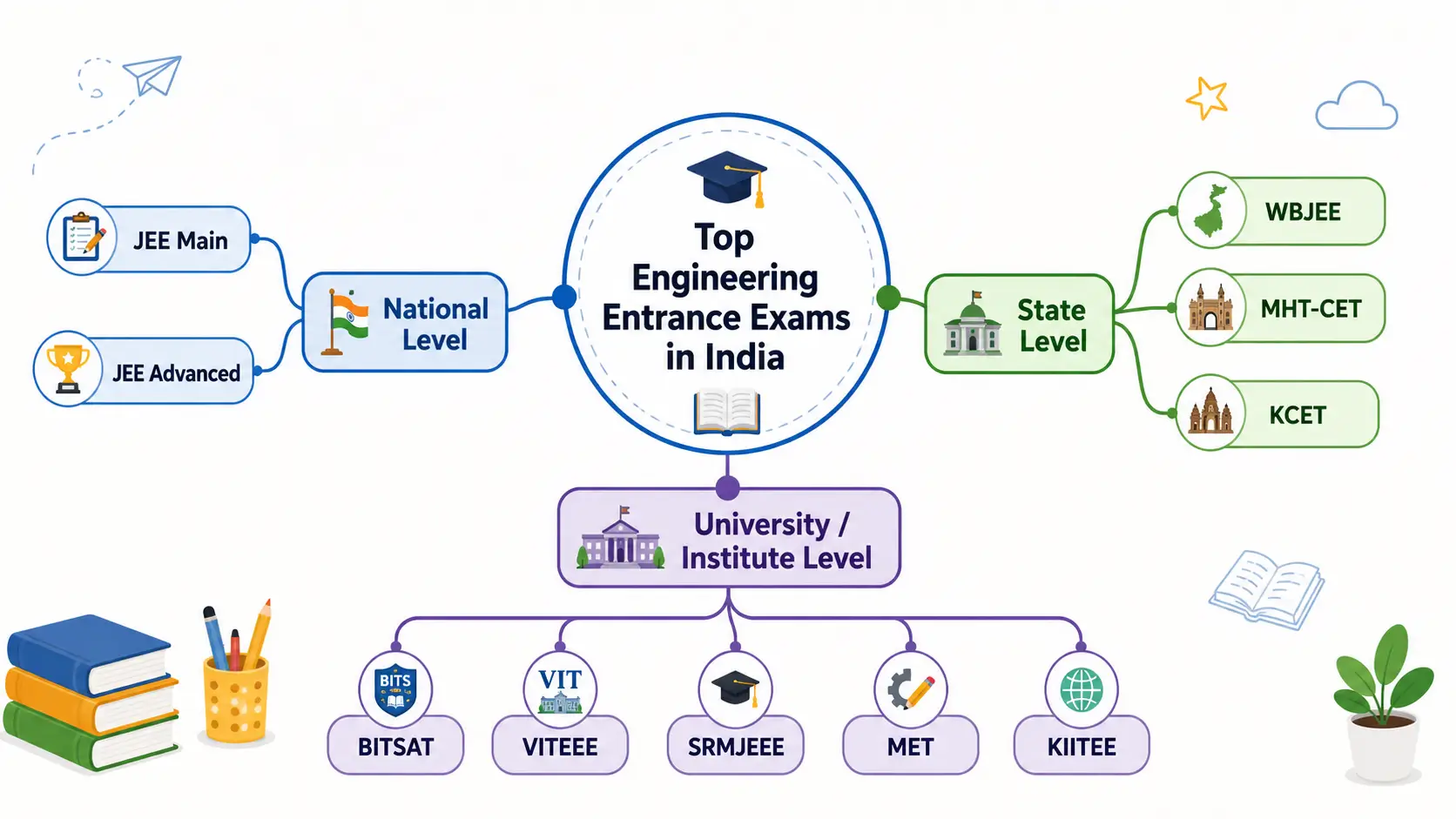
India hosts a plethora of engineering entrance exams, each catering to different institutions and states. The Joint Entrance Examination (JEE) Main and JEE Advanced are perhaps the most well-known, serving as the primary gateways to the IITs, NITs, and other centrally funded technical institutions. JEE Main is conducted by the National Testing Agency (NTA), and it serves as a qualifying exam for JEE Advanced, which is required for admission to the IITs. Both exams are highly competitive and require rigorous preparation.
In addition to the JEE exams, several state-level entrance exams also play a crucial role in the admission process. Exams like the Maharashtra Common Entrance Test (MHT-CET), Karnataka Common Entrance Test (KCET), and West Bengal Joint Entrance Examination (WBJEE) are some of the prominent state-level exams. These exams are designed to prioritize students from their respective states, offering them a chance to secure seats in state-run engineering colleges. Each state has its unique syllabus and exam pattern, making it essential for students to be well-versed with the specific requirements of their state’s exam.
Apart from these, there are other national-level exams like the Birla Institute of Technology and Science Admission Test (BITSAT) and VIT Engineering Entrance Examination (VITEEE). These exams are conducted by private institutions but are highly regarded for their rigorous selection process and the quality of education they offer. BITSAT, for instance, is the entrance exam for Birla Institute of Technology and Science (BITS) campuses in Pilani, Goa, and Hyderabad. VITEEE is conducted by Vellore Institute of Technology (VIT) and is known for its modern curriculum and research opportunities. Understanding the landscape of these exams can help students make informed decisions about their engineering education.
Top Engineering entrance exams in India: A Practical comparison based on research
| Exam | Toughness Profile | What it really tests | Suitable for students who… | Main challenge / Candidate experience |
|---|---|---|---|---|
| JEE Advanced | 🔴 Extreme conceptual depth | Deep PCM understanding, multi-step reasoning, connecting concepts, unfamiliar problems, question selection and stamina | Enjoy difficult problems, can sit with one problem patiently, and genuinely understand concepts rather than only memorising formulas | The official exam explicitly targets comprehension, reasoning and analytical ability. Candidates commonly distinguish it from Main by saying Advanced preparation requires much deeper understanding of concepts and their applications. Two compulsory 3-hour papers also make endurance important. |
| JEE Main | 🔴 High overall, but more structured than Advanced | PCM concepts, accuracy, speed, calculation efficiency and large-syllabus coverage | Have strong NCERT fundamentals, disciplined practice and reasonably good speed; targeting NITs, IIITs and other participating institutions, or qualification for Advanced | Paper 1 has 75 questions for 300 marks in 3 hours with negative marking. Candidate discussions repeatedly describe Main preparation as heavily dependent on speed and accuracy compared with the deeper, more exploratory nature of Advanced. |
| IIIT-H UGEE | 🔴 High, unusual and unpredictable | PCM proficiency followed by research aptitude, logical reasoning and the ability to think through unfamiliar problems; shortlisted candidates also face an interview | Are naturally curious, enjoy puzzles and unconventional problems, and can explain how they think | The 3-hour CBT separates SUPR and REAP; SUPR is used for filtering, while REAP determines the exam-stage ranking for interview shortlisting. Candidates frequently describe UGEE as less predictable than normal PCM entrances and emphasise reasoning and thought process over a fixed preparation template. |
| BITSAT | 🟠 Moderate-to-high concepts, extreme speed pressure | Broad syllabus coverage, instant recall, fast calculations, accuracy under pressure, plus English and logical reasoning | Are naturally fast, accurate, mentally alert for a long stretch and good across many topics | The exam is 3 hours and includes PCM, English and Logical Reasoning; candidates who complete all 130 questions can attempt 12 additional questions under the official rules. Candidate reports frequently describe BITSAT as a “sprint”: even good JEE performers may struggle without separate speed-oriented mock practice. |
| WBJEE | 🟠🔴 High Mathematics pressure | Mathematics strength, calculation speed, careful handling of different question categories and sustained PCM performance | Are particularly strong in Mathematics and want West Bengal engineering options | The official format has separate Mathematics and Physics-Chemistry papers, with 155 questions carrying 200 marks in total and different marking rules across question categories. Candidate reaction to the 2026 examination was especially harsh toward Mathematics, although that is year-specific and future paper difficulty can change. |
| MHT-CET | 🟠 Moderate concepts, very high speed demand | Formula recall, theory clarity, rapid execution and accuracy—especially in Mathematics | Know the syllabus well but are stronger at fast execution than at solving very unfamiliar Advanced-type problems; particularly relevant for Maharashtra engineering admissions | PCM candidates face 150 questions in 180 minutes with no negative marking. The official timing is divided into 90 minutes for Physics-Chemistry and 90 minutes for Mathematics. Candidate advice repeatedly centres on timed practice, short methods, speed and accuracy. |
| COMEDK UGET | 🟠 Moderate concepts, high volume pressure | Fast PCM recall, quick elimination, time management and deciding when to move on | Want access to participating private engineering colleges in Karnataka and perform well in fast MCQ examinations | The examination has 180 questions—60 each in Physics, Chemistry and Mathematics—with no negative marking. Candidate reports commonly say that Mathematics becomes the bottleneck because 180 questions in 3 hours leave little time for lengthy calculations. |
| MET | 🟠 Moderate and balanced | PCM fundamentals, accuracy, numerical-answer handling, English and time management; board performance also matters | Are academically consistent in Class 12 as well as reasonably good in entrance tests | MET has 60 questions in 120 minutes with both MCQ and Numerical Answer Type questions; the current B.Tech merit process gives 50% weight to MET and 50% to qualifying-exam marks. Paper analyses generally describe the overall level as moderate, with Mathematics often the lengthier section. |
| VITEEE | 🟠 Moderate but shift-dependent and fast | Broad PCM coverage, quick recall, aptitude, English and accuracy under time pressure | Are comfortable with a fast CBT and want VIT B.Tech options | The official 2026 structure has 125 questions in 2.5 hours across PCM, Aptitude and English. An important 2026 change is negative marking, which makes indiscriminate guessing less attractive. Candidate reports suggest that difficulty can be uneven: some sections or question types feel direct, while others are unexpectedly calculation- or recall-heavy. |
A student should not choose preparation strategy only by asking, “Which exam has harder questions?”
A better question is:
Am I a deep problem solver, a fast accurate solver, a strong memoriser with fast execution, or an unconventional logical thinker?
That distinction explains why one student can do exceptionally well in JEE Advanced but feel uncomfortable in BITSAT, while another can outperform their JEE Main result in a speed-oriented examination. Candidate discussions strongly support the idea that performance does not transfer perfectly from one exam format to another.
Preparation Tips for Engineering Entrance Exams
Preparing for engineering entrance exams requires a well-structured and disciplined approach. The vast syllabus and competitive nature of these exams can be daunting, but with the right strategy, students can navigate this challenging journey successfully. Here are some essential preparation tips for engineering entrance exams.
- First and foremost, understanding the exam pattern and syllabus is crucial. Each exam has its unique structure, and being familiar with the types of questions, marking scheme, and time allocation can help in effective preparation. Creating a study plan that covers all the topics and allocates sufficient time for revision is essential. Breaking down the syllabus into manageable sections and setting daily, weekly, and monthly goals can keep the preparation on track.
- Regular practice is the key to success in engineering entrance exams. Solving previous years’ question papers, taking mock tests, and practicing sample papers can help in understanding the types of questions and improving speed and accuracy. Time management is a critical skill, and practicing under timed conditions can enhance this ability. Additionally, focusing on weak areas and seeking help from teachers, online resources, or coaching classes can provide the necessary support for improvement.
- Another important aspect of preparation is maintaining a healthy balance between studies and relaxation. Stress and burnout can hamper performance, so it’s essential to take regular breaks, engage in physical activities, and maintain a healthy lifestyle. Staying positive and motivated throughout the preparation journey is equally important. Joining study groups, discussing problems with peers, and staying connected with family and friends can provide emotional support and keep the motivation levels high. With consistent effort, strategic planning, and a positive mindset, students can excel in engineering entrance exams.
List of Engineering Entrance Exams 2026 in India
| Exam | Level | Course | Expected Month Exam Date 2026 |
|---|---|---|---|
| JEE Main | National | B.Tech, B.E. | January & April 2026 |
| JEE Advanced | National | IIT B.Tech | May 2026 |
| BITSAT | University | B.Tech | April and May 2026 |
| CUET UG | National | Multiple Courses | May 2026 |
| VITEEE | University | B.Tech | April 2026 |
| SRMJEEE | University | B.Tech | 3 phases, April and June 2026 |
| MET(Manipal Entrance Test) | University | B.Tech | 2 phases, April and May 2026 |
| COMEDK UGET | State | B.Tech | May 2026 |
| KIITEE | University | B.Tech | 3 phases April, June, July 2026 |
JEE MAIN
JEE Main(Joint Entrance Examination) Main was previously called AIEEE(All India Engineering Entrance Examination):
- It is a national level entrance exam conducted by NTA(National Testing Agency)
- CBT(computer based test)
- It is for admission into undergraduate programs in engineering, architecture and planning
- Technical Institutions like NITs, IIITs, Government Funded Technical Institutions accept students for admission into their courses based on rank in the JEE Main
- JEE main is conducted in 2 sessions, twice every year in Session 1(January) and Session 2(April), students can appear in both attempts; the best score is considered for ranking.
- For B.E/B.Tech(Paper 1), Physics, Chemistry, Maths subjects knowledge is tested
- Duration of the JEE Main exam is 3 hours
- JEE main is an eligibility test for JEE Advanced (Candidates should be among the top 2,50,000 successful candidates (including all categories) in B.E./B.Tech. Paper of JEE(Main) )
- Exam pattern for Paper 1(B.E/B.Tech)
- Negative marking applies to both MCQs and numerical questions. For Section B, the answer should be rounded off to the nearest integer.
- The exam interface allows full flexibility — you can switch between:
- Physics, Chemistry, and Math at any time
- Section A and Section B of any subject in any order
- The cutoff score for qualifying JEE Main varies each year and by category.
| Subject | Section A (MCQ) | Section B(Numerical) | Total Questions (to attempt) | Marks |
|---|---|---|---|---|
| Physics | 20 | 5 | 25 | 100 |
| Chemistry | 20 | 5 | 25 | 100 |
| Mathematics | 20 | 5 | 25 | 100 |
- Key Change for 2025–26 : The optional questions in Section B (Numerical) were removed in 2025. In 2026, all 75 questions (25 per subject) remain mandatory.
- Know more about: JEE Main 2027
JEE ADVANCED
JEE Advanced(Joint Entrance Examination) Advanced was previously called IIT-JEE exam:
- Conducted by one of the seven zonal IITs : IIT Roorkee, IIT Kharagpur, IIT Delhi, IIT Kanpur, IIT Bombay, IIT Madras, IIT Guwhati under JAB(Joint Admission Board)
- CBT(computer based test)
- It is for admission into undergraduate programs in engineering, science and architecture courses in 23 IITs
- JEE Advanced is conducted once a year
- For B.E/B.Tech, Physics, Chemistry, Maths subjects knowledge is tested
- 2 papers of 3 hours each, both papers are compulsory, total 6 hours in a day
- Exam pattern
Paper 1
| Section | Number of Questions | Total Marks | Marking Scheme |
|---|---|---|---|
| 1 | 4 Each question has FOUR options (A), (B), (C) and (D). ONLY ONE of these four options is the correct answer. | 12 | +3 marks for correct answer 0 marks if none of the options is chosen -1 in all other cases |
| 2 | 3 Each question has FOUR options (A), (B), (C) and (D). ONE OR MORE THAN ONE of these four option(s) is(are) correct answers). | 12 | Full marks: +4 if all correct options are chosen Partial marks: +3 if all four options are correct but only three are chosen Partial Marks: +2 if three or more options are correct but ONLY two are chosen, both of which are correct Partial Marks: +1 if two or more options are correct but ONLY one is chosen, and it is correct 0 if none of the options is chosen -2 in all other cases |
| 3 | 6 The answer to each question is a non negative integer | 24 | +4 for the correct answer 0 for no attempts |
| 4 | 4 | 12 | +3 if ONLY the correct option is chosen 0 if none of the options are chosen -1 for wrong attempts |
- For example, in Paper 1 Section 2, in a question, if (A), (B) and (D) are the ONLY three options corresponding to correct answers, then
- choosing ONLY (A), (B) and (D) will get +4 marks
- choosing ONLY (A) and (B) will get +2 marks
- choosing ONLY (A) and (D) will get +2 marks
- choosing ONLY (B) and (D) will get +2 marks
- choosing ONLY (A) will get +1 mark; choosing ONLY (B) will get +1 mark; choosing ONLY (D) will get +1 mark
- choosing no option (i.e. the question is unanswered) will get 0 marks; and choosing any other combination of options will get -2 marks.
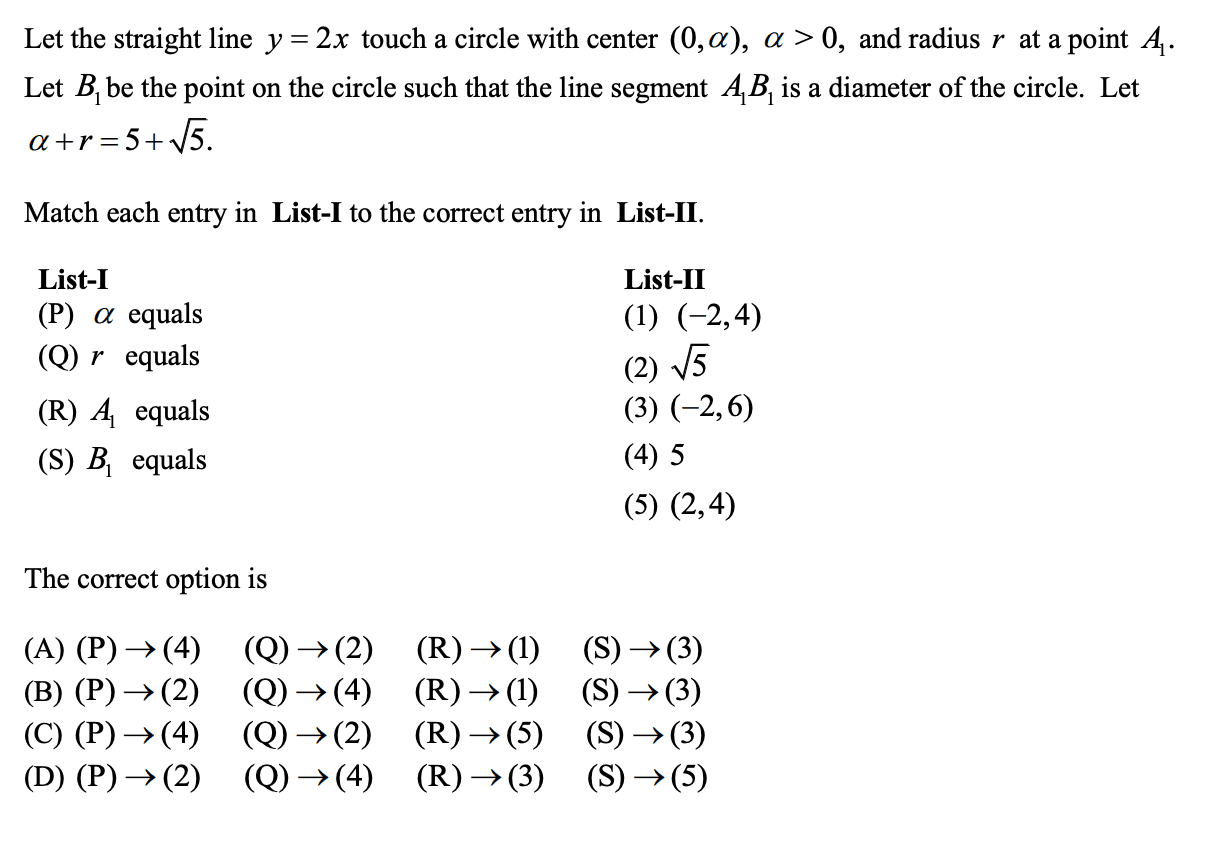
- Paper 1 Section 4, question example
Paper 2
| Section | Number of Questions | Total Marks | Marking Scheme |
|---|---|---|---|
| 1 | 4 | 12 | +3 if ONLY the correct option is chosen 0 if unanswered -1 in all other cases |
| 2 | 3 | 12 | Full marks: +4 if all correct options are chosen Partial Marks: +3 if all four options are correct but only three options are chosen Partial Marks: +2 if three or more correct but only two are chosen both of which are correct Partial Marks: +1 if two or more correct but only one is chosen and it is a correct option 0 if unanswered -2 in all other cases |
| 3 | 6 | 24 | +4 for the correct answer 0 if unanswered no negative marks |
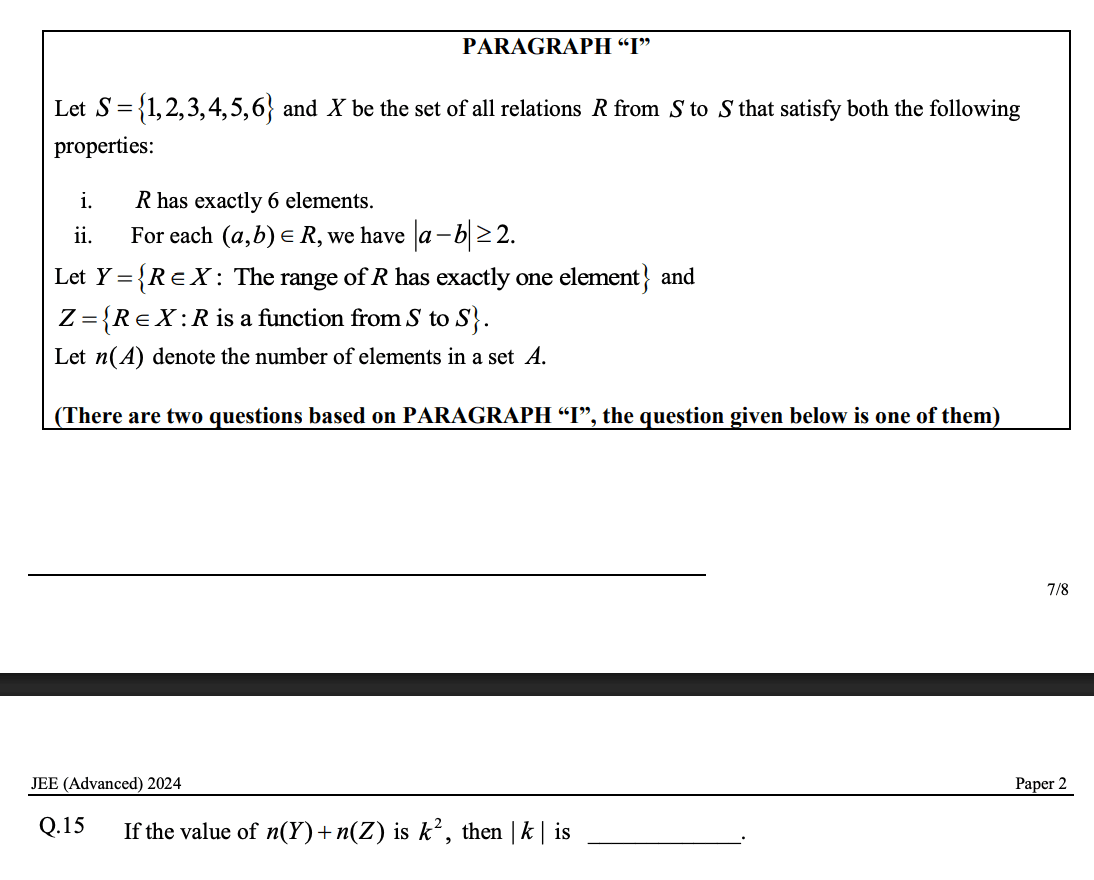
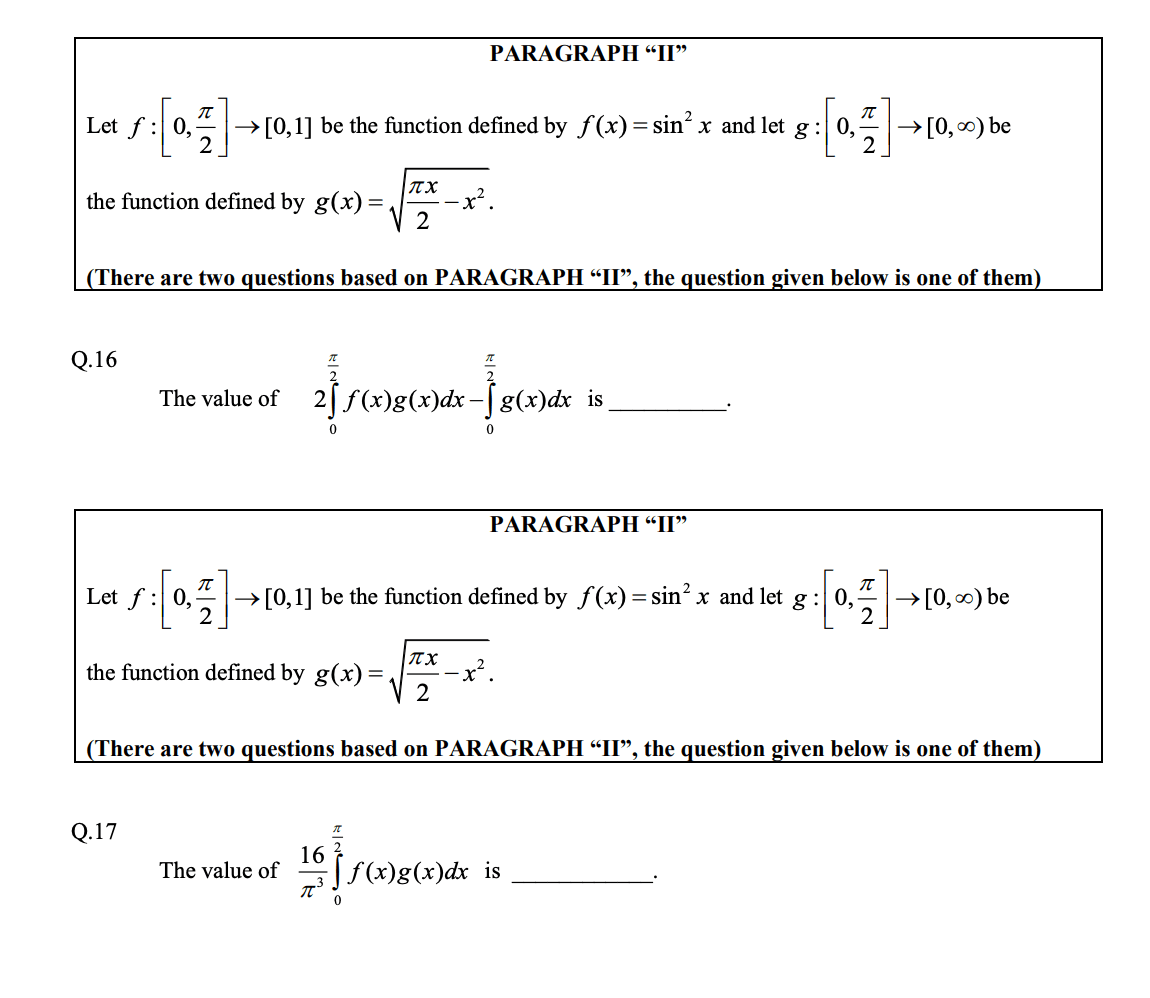
| 4 | 4 This section contains TWO (02) paragraphs. Based on each paragraph, there are TWO (02) questions. The answer to each question is a NUMERICAL VALUE. For each question, enter the correct numerical value of the answer using the mouse and the on-screen virtual numeric keypad in the place designated to enter the answer. If the numerical value has more than two decimal places, truncate/round-off the value to TWO decimal places | 12 | +3 if ONLY the correct option is chosen 0 if unanswered no negative marks |
- Paper 2 Section 4, question example
- In paper 1 and paper 2 Physics, Chemistry, Maths are tested
- Universities like Indian Maritime University Kolkata, Indian Institute of Petroleum and Energy, Rajiv Gandhi Institute of Petroleum Technology, Indian Institute of Space Technology, Indian Institute of Science accept JEE Advanced score for admission into their courses
- University of Cambridge, and National University of Singapore may consider JEE Advanced score for their application process.
- Know more about: JEE Advanced 2027
BITSAT

BITSAT(Birla Institute of Technology and Science Admission Test):
- BITS is a university with Main campus in Pilani, Rajasthan, India
- Other Campuses are in Goa, Hyderabad, Dubai
- Program includes B.E. (Bachelor of Engineering)
- Examination mode is CBT(computer based test)
- Medium of Exam is English
- Candidates should bring a pen for the purpose of rough work, signing etc. A scratch pad for rough work will be provided. Calculators and logarithmic tables are not allowed in the test centres.
- Physics, Chemistry, English Proficiency, Logical Reasoning, Mathematics/ Biology are tested
- Eligibility is 10+2 (Physics, Chemistry, Maths; or Biology for B.Pharm.) with minimum 75% aggregate and Minimum 60% individually in Physics, Chemistry, and Math/Biology, both theory and practical components must be considered while calculating percentages. Students who retake Class 12 for all subjects are now ineligible, BITSAT has become stricter with droppers. If you are repeating Class 12 entirely to improve your score, BITS Pilani now marks you as ineligible. You are only eligible if you are appearing for Class 12 for the first time in 2026 or if you passed in 2025 and are only appearing for “Improvement” in one or two subjects.
- Total number of questions are 130, Physics 30 questions, Chemistry 30 questions, English Proficiency 10 questions, Logical reasoning 20 questions, Mathematics/Biology(B.Pharma) 40 questions
- Exam pattern for B.E.
| Section | Subjects | No. of Questions | Marks Per Question | Total Marks |
|---|---|---|---|---|
| Part 1 | Physics | 30 | 3 | 90 |
| Part 2 | Chemistry | 30 | 3 | 90 |
| Part 3 | (a) English Proficiency (10 Qs) | 10 | 3 | 30 |
| (b) Logical Reasoning (20 Qs) | 20 | 3 | 60 | |
| Part 4 | Mathematics / Biology (for B.Pharm) | 40 | 3 | 120 |
| Total | 130 | 390 |
- MCQ questions, marking scheme is for every correct answer +3 marks are given and for every incorrect answer -1 is deducted
- While the candidate can skip a question, the computer will not allow the candidate to choose more than one option as the correct answer.
- Total duration of exam is 3 hours
- After answering all 130 questions, if you still have time left, you can opt to answer 12 extra questions, these extra questions will be from Physics, Chemistry, Mathematics/ Biology and Logical Reasoning only; three questions from each of them to increase your score.
But you can’t go back to the original questions once you choose this.
CUET UG
CUET(Common University Entrance Test):
- It is a national-level entrance exam conducted by NTA (National Testing Agency) for admission to undergraduate (UG), postgraduate (PG), and Ph.D. courses in central, state, deemed, and private universities across India.
- CBT(Computer based test)
- Rough sheets for calculations will be provided.
- Exam Pattern
| Section | Subjects | No. of Questions to Attempt | Total Questions | Marks per Question | Total Marks |
|---|---|---|---|---|---|
| Section I | Languages (13 options, e.g., English, Hindi) | 50 | 50 | 5 | 250 |
| Section II | Domain-specific subjects (23 subjects offered) | 50 | 50 | 5 | 250(per subject) |
| Section III | 1 General Aptitude Test | 50 | 50 | 5 | 250 |
- Choice of Subjects: Candidates may choose upto a maximum of five (05) subjects including languages and General Aptitude Test irrespective of the subjects opted in class XII
- MCQ types questions, each correct answer +5 marks, wrong answer -1 mark, no answer 0 mark
- Major Central Universities like Delhi University (DU), Banaras Hindu University (BHU), Jamia Millia Islamia (JMI), Jawaharlal Nehru University (JNU), and many others use CUET UG scores
- State Universities: e.g., BBAU Lucknow, Dr. Harisingh Gour Vishwavidyalaya accept CUET UG scores
- Deemed/Private Universities, many are joining every year (like Galgotias, Shiv Nadar University) use CUET UG scores
- Before CUET, universities had their own entrance exams or admitted based on Class 12 marks. Now CUET provides a common platform and equal opportunity for students across boards and regions. Important: CUET is mandatory for admissions into central universities.
- For Engineering programs through CUET UG, you should choose Physics + Chemistry + Maths (PCM), English as Language Paper, General Test only if required by the university.
- UGC New Rule: Students can now choose any domain subject regardless of their Class 12 stream (e.g., a Science student can pick History). Total subjects reduced to 37 (Entrepreneurship & others removed). If you plan to change your career path (e.g., moving from Science to Liberal Arts), the 2026 cycle is much easier. Previously, many universities required you to take CUET subjects that you studied in Class 12. The new UGC mandate allows you to pick subjects based on what you want to study in college, not what you studied in school.
VITEEE

VITEEE(Vellore Institute of Technology Engineering Entrance Exam):
- One of India’s top private engineering entrance exams
- VITEEE is the entrance exam for admission to B.Tech programs at VIT Group of Institutions:
- VIT Vellore
- VIT Chennai
- VIT Bhopal
- VIT-AP (Amaravati)
- Mode of exam is CBT(Computer based Test)
- The method of Equi-percentile is adopted for the rank list preparation of VITEEE-Computer Based Examination.
- Duration of exam is 2 hrs 30 mins
- Multiple Choice Questions (MCQs)
- +4 mark for correct answer, 0 for the wrong answer, Negative marking introduced (-1 for wrong).
- Choose Maths group for Engineering, Biology group is for B.Tech in Biotechnology, etc.
- VITEEE is mandatory for admission to the B.Tech. Programme in VIT. Higher Secondary Board, JEE Main/ SAT scores will not be considered for admission to the B.Tech. Degree programme
- Exam pattern
| Subject | Number of Questions |
|---|---|
| Mathematics/Biology | 40 |
| Physics | 35 |
| Chemistry | 35 |
| English | 5 |
| Aptitude | 10 |
| Total | 125 questions |
SRMJEEE
SRMJEEE(SRM Joint Engineering Entrance Examination):
- SRMJEEE is the gateway to B.Tech programs at SRM Institute of Science and Technology’s campuses in Vellore, Chennai, Delhi-NCR, Andhra Pradesh, and Sonepat.
- SRMJEEE is a Computer-Based Test (CBT) conducted from home, the exam is held in Remote Proctored Mode, so you can take it from your home using a laptop/desktop with webcam and internet connection.
- Duration of exam is 2 hrs 30 mins
- MCQs with 4 options and you must choose one correct answer
- Marking Scheme: +1 mark for each correct answer; no negative marking
- Total Questions: 130
- Sections:
- Physics: 35 questions
- Chemistry: 35 questions
- Mathematics or Biology: 40 questions
- English: 5 questions
- Aptitude: 10 questions
- You can choose Maths if you’re going for regular engineering streams, or Biology if you’re opting for Biotech-related courses.
MET(Manipal Entrance Test)
MET(Manipal Entrance Test):
- MET (Manipal Entrance Test) is the entrance exam conducted by Manipal Academy of Higher Education (MAHE) for admission to its undergraduate engineering programs (B.Tech) at:
- Manipal Institute of Technology (MIT), Manipal
- MIT Bengaluru campus
- It is a computer based test
- Medium of Exam is English
- Duration of the exam is 2 hours
- Total marks of the exam is 240
- Exam pattern(B.Tech):
- MCQs
| Subject | Number of Questions |
|---|---|
| Mathematics | 15 |
| Physics | 10 |
| Chemistry | 10 |
| English | 10 |
| Total | 60 questions |
- Numerical Answer Type (NAT): Mathematics (5), Physics (5), and Chemistry (5)
- Marking Scheme
- MCQ: +4 for every correct answer, -1 for every wrong answer, 0 for every unanswered question
- NAT: +4 for every correct answer, 0 for every wrong, 0 for every unanswered question
COMEDK UGET

- COMEDK UGET is the Consortium of Medical, Engineering and Dental Colleges of Karnataka Undergraduate Entrance Test
- It is a computer based test
- Medium of Exam is English only
- Duration of the exam is 3 hours
- Total marks of the exam is 180
- Exam pattern(B.E/B.Tech):
| Subject | Number of Questions |
|---|---|
| Mathematics | 60 |
| Physics | 60 |
| Chemistry | 60 |
| Total | 180 questions |
- Marking Scheme
- MCQs: +1 for every correct answer, no negative marking for wrong answer
- Ramaiah Institute of Technology, R.V. College of Engineering, Jain Deemed-to-be University, Siddaganga Institute of Technology, BMS College of Engineering and CMR Institute of Technology are the top Engineering colleges in India accepting COMEDK UGET score
KIITEE

- KIITEE is the Entrance Examination for KIIT Deemed to be University
- It is a computer based test
- Medium of Exam is English only
- Duration of the exam is 2.5 hours
- Total marks of the exam is 480
- Exam pattern(B.Tech):
| Subject | Number of Questions |
|---|---|
| Mathematics | 40 |
| Physics | 40 |
| Chemistry | 40 |
| Total | 120 questions |
- Marking Scheme
- MCQs: +1 for every correct answer, there is negative marking, 1 mark will be deducted for every wrong answer.
- For admission to KIIT’s B.Tech (regular) programs, candidates must have passed 10+2 with Physics, Chemistry, and Mathematics, securing at least 60% aggregate marks. For the B.Tech & M.Tech (Biotechnology) dual-degree program, candidates must have passed 10+2 with Physics, Chemistry, and either Mathematics or Biology/Biotechnology, also with a minimum of 60% aggregate marks.
Common Mistakes to Avoid During Preparation
While preparing for engineering entrance exams, students often make certain mistakes that can affect their performance. Being aware of these common pitfalls and avoiding them can significantly enhance the chances of success. Here are some common mistakes to avoid during preparation.
- One of the most common mistakes is neglecting the importance of a well-structured study plan. Many students dive into preparation without a clear strategy, leading to haphazard study sessions and incomplete syllabus coverage. Creating a detailed study plan that includes all subjects, topics, and revision schedules is crucial. Sticking to the plan and making necessary adjustments based on progress can ensure comprehensive preparation.
- Another mistake is over-reliance on rote learning. Engineering entrance exams are designed to test the understanding of fundamental concepts and problem-solving abilities. Simply memorizing formulas and facts without grasping the underlying principles can be detrimental. Focusing on conceptual clarity, understanding the applications of concepts, and practicing problem-solving can lead to better performance. Additionally, ignoring weaker subjects or topics can create significant gaps in knowledge, so it’s essential to give equal attention to all areas.
- Lastly, inadequate practice and revision can hinder success. Many students underestimate the importance of regular practice and fail to solve enough mock tests and previous years’ question papers. Practicing under exam-like conditions can improve time management, accuracy, and confidence. Regular revision is equally important to retain information and reinforce learning. Avoiding these common mistakes and adopting a disciplined and strategic approach can greatly enhance the chances of excelling in engineering entrance exams.
Future Prospects in Engineering Education
Engineering entrance exams in India are a critical step towards securing admission to prestigious engineering institutions and building a successful career. From national-level exams like JEE Main and JEE Advanced to state-level exams and other national-level exams conducted by private institutions, the landscape of engineering entrance exams is diverse and competitive. Understanding the importance of these exams, being familiar with their structure and syllabus, and adopting a strategic preparation approach can significantly enhance the chances of success.
The future prospects in engineering education are promising, with advancements in technology and the increasing demand for skilled engineers across various industries. Engineering graduates have a wide range of career opportunities in fields like information technology, electronics, mechanical engineering, civil engineering, and biotechnology, to name a few. Additionally, the emphasis on innovation, research, and entrepreneurship in engineering education opens doors to exciting and fulfilling career paths.
As technology continues to evolve, the role of engineers in shaping the future becomes even more significant. From developing sustainable solutions to addressing global challenges, engineers play a crucial role in driving progress and improving the quality of life. Aspiring engineers who excel in entrance exams and pursue quality education can look forward to a rewarding career that combines technical expertise with the opportunity to make a positive impact on society. With dedication, hard work, and a passion for learning, the journey towards a successful engineering career can be both exciting and fulfilling.
FAQs(Frequently Asked Questions)
Which are the best engineering entrance exams in India?
If aiming for top-tier education and opportunities, JEE Advanced is the best. For broader access to quality institutions, JEE Main is essential. For private, well-ranked institutes, BITSAT is a strong option. Ultimately, the best engineering entrance exam in 2026 depends on the college you want. JEE Main and JEE Advanced are considered the top exams because they provide admission to prestigious institutes like NITs, IIITs, and IITs. Other popular exams include BITSAT, VITEEE, SRMJEEE, MET, and COMEDK UGET, which offer admission to top private engineering colleges in India.
How many engineering entrance exams are there in India?
There are more than 20 engineering entrance exams in India conducted at national, state, and university levels. Popular exams include JEE Main, JEE Advanced, BITSAT, VITEEE, SRMJEEE, COMEDK UGET, WBJEE, MHT CET, and KIITEE.
Can I get admission in engineering without entrance exam in India?
Yes, it is possible to get admission to a B.Tech or BE programme in India without appearing for an engineering entrance examination. However, this option is mainly available in certain private universities and colleges. The admission process depends on the rules of the institution, the state, and the type of seat available.
For admission to prestigious institutions such as IITs, NITs, IIITs, and many government-funded technical institutions, students are generally required to qualify through entrance examinations such as JEE Main and JEE Advanced.
However, several private universities and engineering colleges offer admission through other routes. Some institutions consider Class 12 board examination marks, especially the student’s performance in Physics, Chemistry, and Mathematics. Admission may be offered on the basis of merit, subject to the eligibility criteria and availability of seats.
Another possible route is institute-level or direct admission. In some colleges, vacant seats remaining after the regular counselling process may be filled on the basis of Class 12 marks. Certain institutions may also have management or institutional quota seats, depending on the applicable regulations.
Students who have completed a diploma in engineering may also be eligible for lateral entry into the second year of a B.Tech or BE programme. The admission procedure for lateral entry varies between states and institutions. Some colleges use merit-based admission, while others require a separate entrance examination.
Therefore, JEE is not compulsory for studying engineering in India. However, students should understand that admission requirements differ greatly from one college to another.
Students can enter engineering through several pathways:
• JEE Main or JEE Advanced for major government engineering institutions.
• University-specific entrance examinations for many private universities.
• Class 12 board-merit admission in selected institutions.
• Direct or institute-level admission where permitted.
• Management or institutional quota seats, subject to regulations.
• Lateral entry after completing an engineering diploma.
Students who do not wish to appear for an engineering entrance examination should carefully check colleges that officially offer admission based on Class 12 merit or other non-entrance pathways. It is always advisable to verify the eligibility criteria, approval status, placement record, fees, and admission rules of the institution before applying.
Is JEE compulsory for engineering?
No, JEE is not compulsory for engineering. Many private universities conduct their own entrance exams such as BITSAT, VITEEE, SRMJEEE, MET, and KIITEE. Students can also get admission through state-level entrance exams or merit-based admission in some colleges.
Which engineering entrance exam has highest acceptance?
JEE Main has the highest acceptance because it is accepted by NITs, IIITs, GFTIs, and many private engineering colleges across India. It is one of the most widely accepted engineering entrance exams.
Which engineering entrance exams are easiest?
The difficulty level varies for each student, but generally the following exams are considered comparatively easier than JEE Advanced:
VITEEE
SRMJEEE
KIITEE
MET
COMEDK UGET
However, preparation is still required to secure a good rank.