

When we multiply any number by integer, the answer is called multiple
For example, if we want to find multiples of 3, we multiply 3 by integers like -3, -2, -1, 0, 1, 2, 3
3✖️-3 = -9
3✖️-2 = -6
3✖️-1 = -3
3✖️ 0 = 0
3✖️1 = 3
3✖️2 = 6
3✖️3 = 9
So multiples of 3 are …, −9, −6, −3, 0, 3, 6, 9, …
A number has infinite number of multiples
Common Multiple
Suppose we need to find the common multiples of 4 and 5
The multiples of 4 are: 4,8,12,16,20,24,28,32,36,40,44,…
The multiples of 5 are: 5,10,15,20,25,30,35,40,45,50,…
As we can see, common multiples, that is, the numbers which appear in both of multiples of 4 and 5 are 20, 40, 60, 80…
These are simply common multiples
LCM(Least Common Multiple)
LCM, as the full form suggests, is the least or smallest of the common multiples of the given numbers
Common multiples of 4 and 5 are 20, 40, 60, 80…
Least or smallest of them is 20
So LCM of 4 and 5 is 20
Note that 20 is the smallest number that is exactly divisible by all the given numbers which are 4 and 5
20 divided by 4 gives 5 and 20 divided by 5 gives 4
So, LCM is the smallest positive number that is exactly divisible by all the given numbers.
Methods of Finding LCM
1. Prime Factorisation Method
In this method, we express each number as a product of prime factors and multiply all the prime factors, taking the greatest power of each factor, to obtain the LCM.
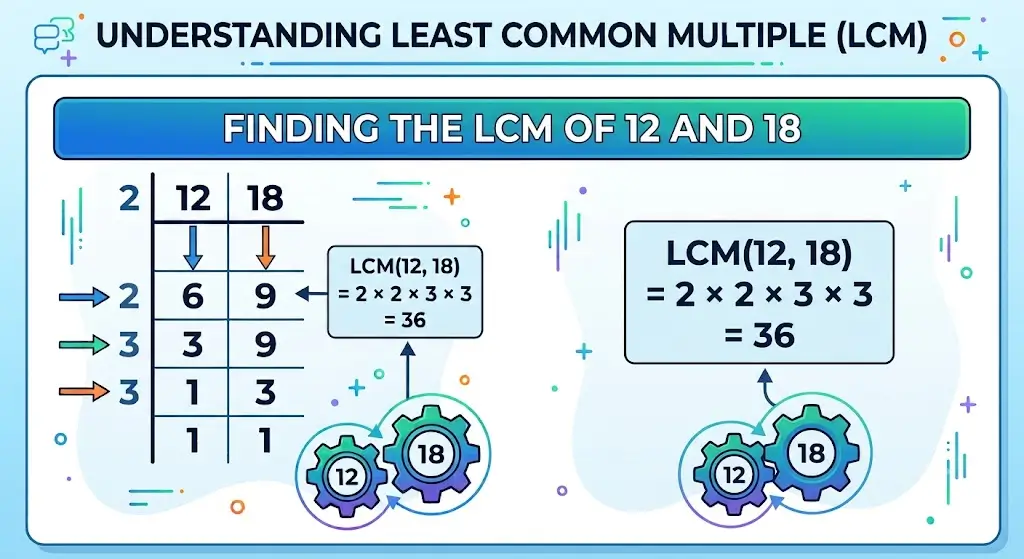
Example: Find the LCM of 12 and 18.
12 = 2 × 2 × 3 = 2² × 3
18 = 2 × 3 × 3 = 2 × 3²
Take the greatest power of each prime factor:
LCM = 2² × 3²
LCM = 4 × 9
LCM = 36
2. Common Division Method
In this method we write the numbers together and divide them by prime numbers until all the quotients become 1.
A number that is not divisible by the chosen divisor is written unchanged in the next row.