

Addition in Maths is one of the four basic arithmetic operations. It is the process of combining two or more numbers, quantities, or objects to find the total.
In simple words, addition means putting things together and finding how many there are altogether.
Addition is the mathematical operation used to combine two or more numbers into a single total value called the sum.
Example
Here:
- 5 and 3 are combined.
- The total obtained is 8.
Parts of Addition
Every addition statement consists of three important parts.
Example: 12+8 = 20
| Part | Meaning |
|---|---|
| 12 | Addend |
| 8 | Addend |
| + | Addition Symbol |
| 20 | Sum |
Addends
The numbers being added together are called addends.
Example:
- 7 = Addend
- 4 = Addend
Addition Symbol (+)
The symbol “+” represents addition.
It tells us that the numbers should be combined.
Example:
Sum
The result obtained after addition is called the sum.
Example:
- 25 is the sum
Methods of Addition
There are several methods used for addition.
1. Addition Using Number Line
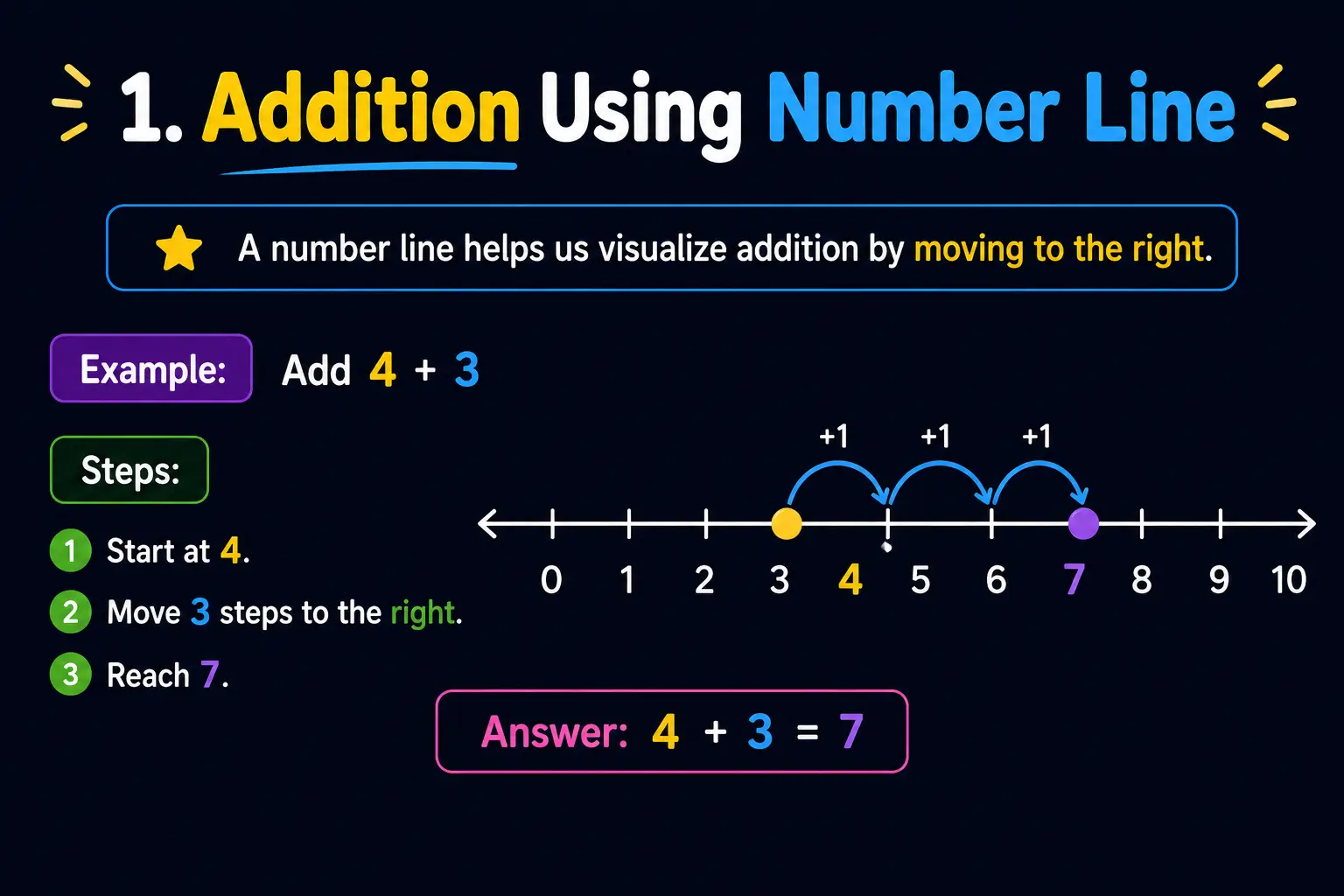
A number line helps us visualize addition by moving to the right.
Example: Add 4 + 3
Steps:
- Start at 4.
- Move 3 steps to the right.
- Reach 7.
Answer: 4 + 3 = 7
Advantages:
• Easy for beginners.
• Improves number sense.
• Helps understand positive numbers.
2. Addition by Counting Forward
In this method, we start from the first number and count forward until we reach the required number of counts.
Example: Add 5 + 4
Start from 5 and count four numbers forward: 6, 7, 8, 9.
Answer: 5 + 4 = 9
Advantages:
• Simple and quick for small numbers.
• Builds counting skills.
• Useful for mental mathematics.
3. Vertical Addition
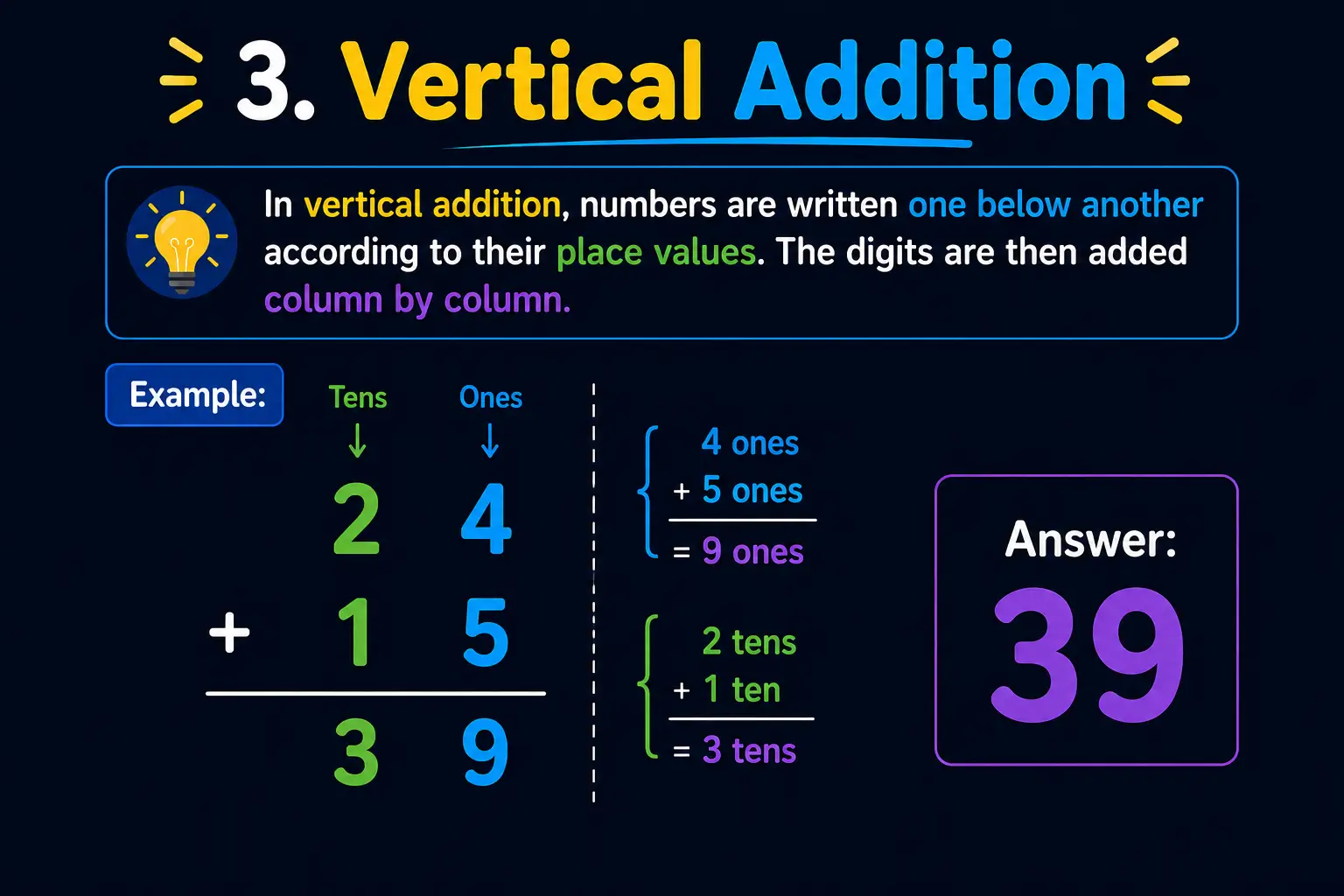
In vertical addition, numbers are written one below another according to their place values. The digits are then added column by column.
Example:
  24
+ 15
----
  39
Answer: 39
Advantages:
• Keeps numbers organized.
• Useful for larger numbers.
• Reduces calculation errors.
4. Addition by Regrouping (Carrying)
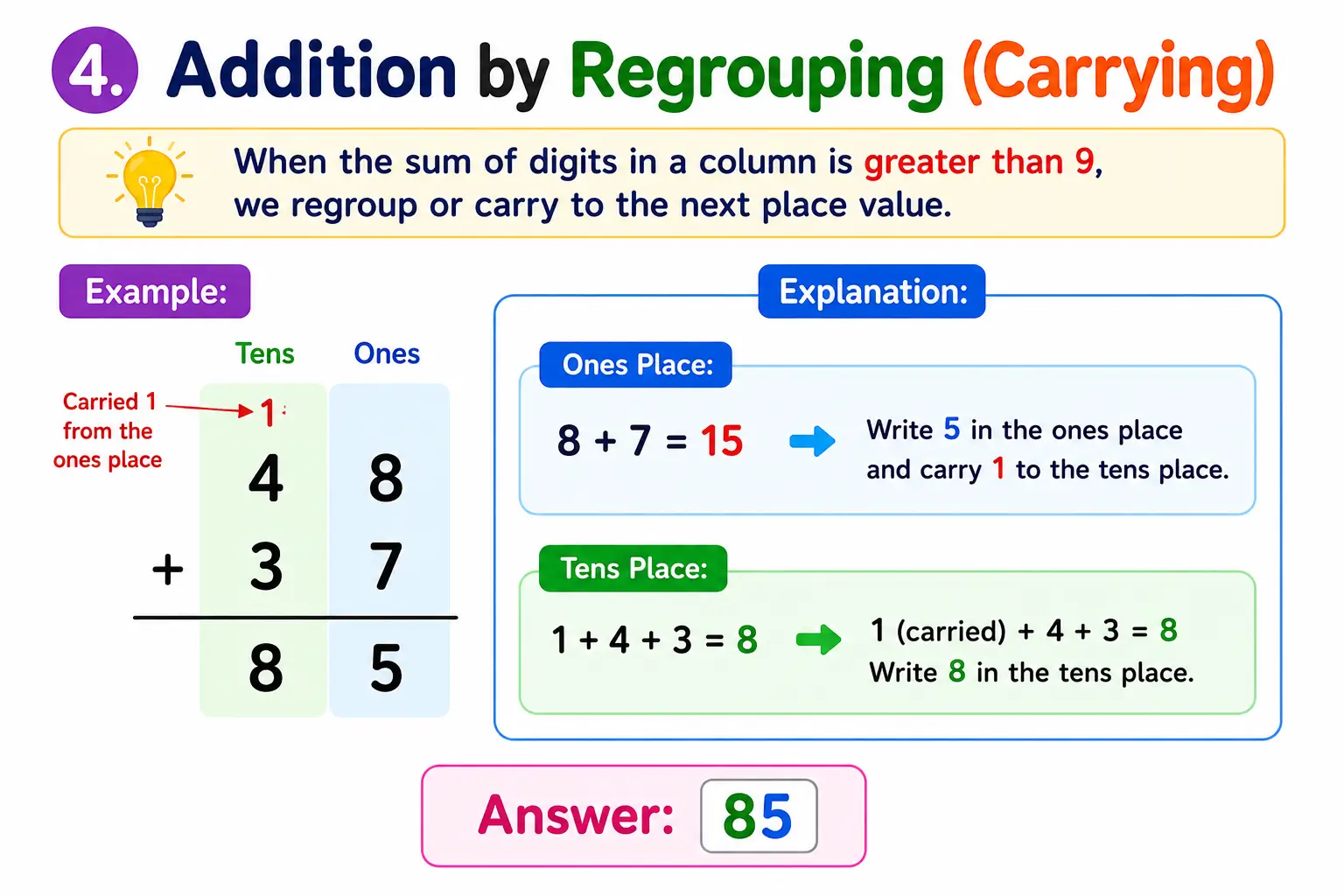
When the sum of digits in a column is greater than 9, we regroup or carry to the next place value.
Example:
  48
+ 37
----
  85
Explanation:
Ones Place: 8 + 7 = 15
Write 5 in the ones place and carry 1 to the tens place.
Tens Place: 1 + 4 + 3 = 8
Answer: 85
In this example, regrouping means making a group of 10 ones and carrying it to the tens place.
Here:
48 + 37
First add the ones place:
8 ones + 7 ones = 15 ones
But we cannot write 15 in the ones column. So we regroup:
15 ones = 1 ten + 5 ones
So:
- Write 5 in the ones place.
- Carry 1 ten to the tens place.
Then add the tens place: 1 carried ten + 4 tens + 3 tens = 8 tens
So the answer is: 85
In simple words, regrouping means exchanging 10 ones for 1 ten when the sum is greater than 9.
Advantages:
• Helps solve larger addition problems.
• Follows place value rules correctly.
• Essential for multi-digit addition.
Adding 2 digit, 3 digit and large numbers
Addition of 2-digit, 3-digit and large numbers is done by writing numbers one below another according to their place values. Then we add the digits column by column, starting from the ones place.
Place values must be arranged properly:
Ones below ones
Tens below tens
Hundreds below hundreds
Thousands below thousands
1. Addition Without Regrouping
When the sum of digits in each column is 9 or less, we add directly. No carrying is needed.
Example: 2-Digit Addition
  23
+ 14
----
  37
Answer: 37
Example: 3-Digit Addition
  123
+ 245
-----
  368
Answer: 368
2. Addition With Regrouping
When the sum of digits in a column is greater than 9, we write the ones digit and carry the tens digit to the next place value.
Example: 2-Digit Addition With Regrouping
   56
+  28
-----
   84
Steps:
Ones place:
6 + 8 = 14
Write 4 in the ones place and carry 1 to the tens place.
Tens place:
1 + 5 + 2 = 8
Answer: 84
3. Addition of 3-Digit Numbers With Regrouping
Example
   487
+  356
------
   843
Steps:
Ones place:
7 + 6 = 13
Write 3 and carry 1.
Tens place:
1 + 8 + 5 = 14
Write 4 and carry 1.
Hundreds place:
1 + 4 + 3 = 8
Answer: 843
4. Addition of Large Numbers
Large numbers are added in the same way. We arrange the digits according to place value and add from right to left.
Example
   4567
+  3289
-------
   7856
Steps:
Ones place: 7 + 9 = 16 → write 6, carry 1
Tens place: 1 + 6 + 8 = 15 → write 5, carry 1
Hundreds place: 1 + 5 + 2 = 8
Thousands place: 4 + 3 = 7
Answer: 7,856
Key Point
Whether the numbers are 2-digit, 3-digit, or large numbers, the method is the same:
Arrange according to place value → Add from ones place → Regroup if needed → Write the final sum.