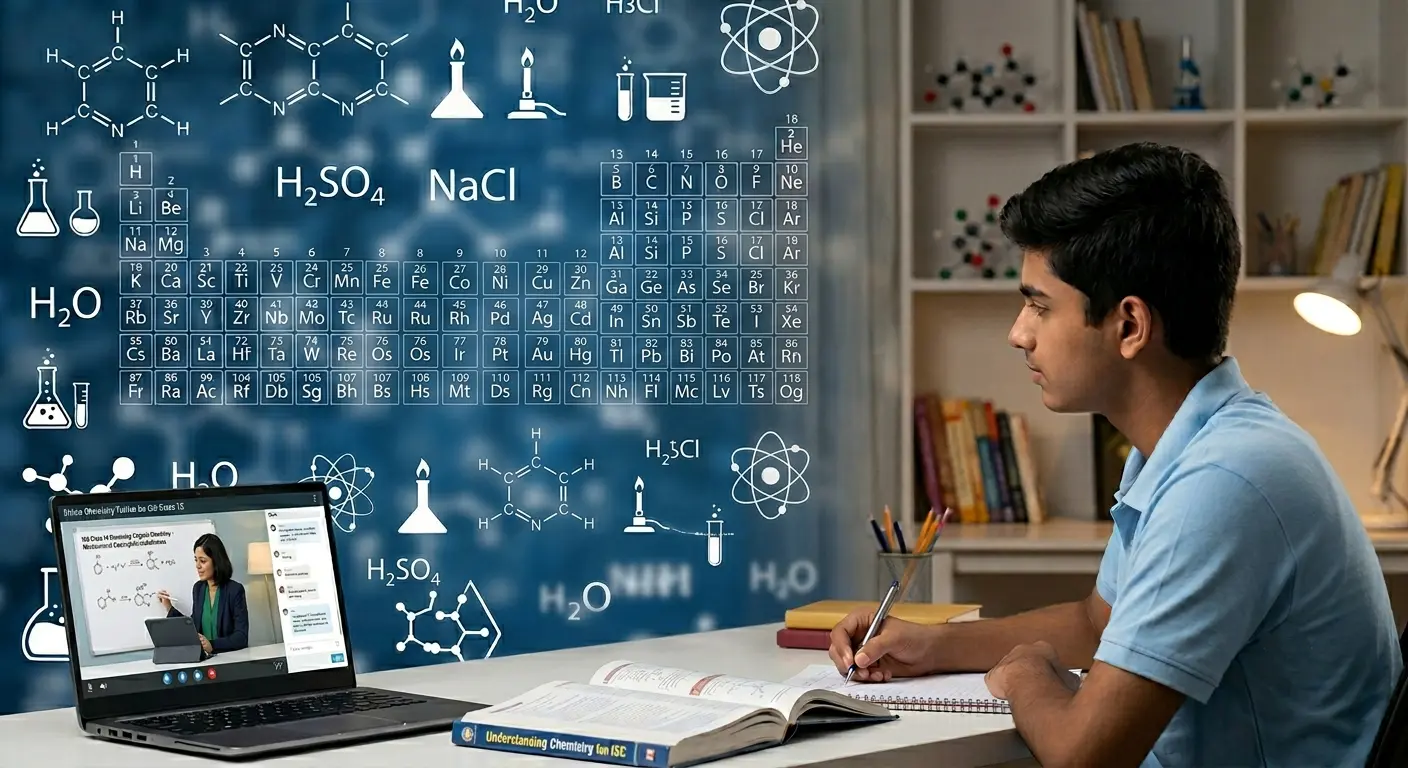
unipolaris academy provides good quality, interactive and personalized online chemistry tuition for ISC Class 12. At unipolaris academy, we offer comprehensive ISC online tuition for Class 12, designed to help students grasp key concepts with clarity and confidence.
Benefits in Online Chemistry Tuition for ISC Class 12
We enrol qualified and experienced ISC Class 12 Online Chemistry Tuition Tutors with pen tablet. The tutors have good command over subjects and have fluent communication skills
One to one teacher to student ratio ensures personal attention to the student
Regular Assignments are given and their evaluation is done timely
Questions complementing school curriculum are given for practice and solved along with students
Regular Doubts Resolution – Doubts of the students are cleared before moving on to the next concepts
Recording after the live class is provided in a folder for revision purpose so that student can go through concepts again if they are not able to understand in the live class
Focus is on clearing the basics of the student as once the basics are cleared they can build upon the basics to solve higher order problems
Personal Attention to the Student for focused learning – Personal attention is given to the student as teacher asks questions regularly during the live class thus enabling the teacher to understand the comprehension level of the student
Free Live Demo offered before Parent and student decides to go for regular classes
Syllabus in Online Chemistry Tuition for ISC Class 12
Section A: Physical Chemistry
- Solutions
- Types of solutions, expression of concentration of solutions of solids in liquids (molarity, molality, mole fraction, ppm).
- Solubility of gases in liquids (Henry’s Law), Raoult’s Law for volatile and non-volatile solutes, ideal and non-ideal solutions, and azeotropic mixtures.
- Colligative properties: Relative lowering of vapour pressure, elevation of boiling point, depression of freezing point, and osmotic pressure; determination of molecular mass using colligative properties.
- Abnormal molecular mass, van ‘t Hoff factor, degree of dissociation, and association with related numerical problems.
- Electrochemistry
- Redox reactions, conductance in electrolytic solutions, specific and molar conductivity, variations of conductivity with concentration, and Kohlrausch’s Law.
- Electrolytic cells and Galvanic cells, EMF of a cell, standard electrode potential, Nernst equation and its applications, and the relationship between cell potential and Gibbs energy change.
- Faraday’s Laws of electrolysis, dry cell, electrolytic cells, lead accumulator, fuel cells, and the mechanism of corrosion.
- Chemical Kinetics
- Rate of a reaction (average and instantaneous), factors affecting rates (concentration, temperature, catalyst).
- Rate law, specific rate constant, order and molecularity of a reaction.
- Integrated rate equations and half-life (restricted to zero and first-order reactions).
- Concept of collision theory (elementary idea, no mathematical treatment), activation energy, and the Arrhenius equation.
Section B: Inorganic Chemistry
d- and f-Block Elements
- General introduction, electronic configuration, occurrence, and characteristics of transition metals.
- General trends in properties of the 3d-series: Metallic character, ionization enthalpy, oxidation states, ionic radii, color, catalytic properties, magnetic properties, interstitial compounds, and alloy formation.
- Preparation, structures, and chemical properties
- Lanthanoids: Electronic configuration, oxidation states, chemical reactivity, and lanthanoid contraction with its consequences.
- Actinoids: Electronic configuration, oxidation states, and comparison with lanthanoids.
Coordination Compounds
- Introduction, ligands, coordination number, color, magnetic properties, shapes, and IUPAC nomenclature of mononuclear coordination compounds.
- Isomerism (structural and stereoisomerism).
- Werner’s coordination theory, Valence Bond Theory (VBT), and Crystal Field Theory (CFT) (octahedral and tetrahedral splitting); importance of coordination compounds in qualitative analysis, extraction of metals, and biological systems.
Section C: Organic Chemistry
Haloalkanes and Haloarenes
- Haloalkanes: Nomenclature, nature of C–X bond, physical and chemical properties, mechanisms of nucleophilic substitution reactions
- Haloarenes: Nature of C–X bond, electrophilic substitution reactions, and the directive influence of halogens in monosubstituted compounds.
- Uses and environmental effects of dichloromethane, trichloromethane, tetrachromethane, iodoform, freons, and DDT.
Alcohols, Phenols, and Ethers
- Alcohols: Nomenclature, methods of preparation, physical and chemical properties (of primary alcohols only); identification of primary, secondary, and tertiary alcohols (Lucas test); mechanism of dehydration.
- Phenols: Nomenclature, methods of preparation, physical and chemical properties, acidic nature of phenol, electrophilic substitution reactions, Kolbe’s reaction, and Reimer-Tiemann reaction.
- Ethers: Nomenclature, methods of preparation (Williamson’s synthesis), physical and chemical properties, and uses.
Aldehydes, Ketones, and Carboxylic Acids
- Aldehydes and Ketones: Nomenclature, nature of carbonyl group, methods of preparation, physical and chemical properties, mechanism of nucleophilic addition, reactivity of alpha-hydrogen in aldehydes, Aldol condensation, Cannizzaro reaction, and nucleophilic addition-elimination reactions.
- Carboxylic Acids: Nomenclature, acidic nature, methods of preparation, physical and chemical properties, and reactions (salt formation, decarboxylation, Hell-Volhard-Zelinsky reaction).
Organic Compounds Containing Nitrogen (Amines)
- Amines: Nomenclature, classification, structure, methods of preparation, physical and chemical properties, basic character of amines, and secondary/tertiary distinction tests.
- Aniline: Preparation, properties, and electrophilic substitution reactions.
- Cyanides and Isocyanides: Preparation and synthetic importance.
- Diazonium Salts: Preparation, chemical reactions, and importance in synthetic organic chemistry.
Biomolecules
- Carbohydrates: Classification (aldoses and ketoses), monosaccharides (glucose and fructose structure/reactions), oligosaccharides (sucrose, lactose, maltose), and polysaccharides (starch, cellulose, glycogen); importance.
- Proteins: Elementary idea of alpha-amino acids, peptide bonds, polypeptides, proteins, primary/secondary/tertiary/quaternary structures (qualitative idea only), and denaturation of proteins; enzymes.
- Nucleic Acids: Chemical composition of DNA and RNA, double-helical structure of DNA.
- Vitamins: Classification (fat-soluble and water-soluble) and their deficiency diseases
.
Testimonials
⭐ The Concept-Clearer
Sunita Sharma, Parent (Kolkata)
“My daughter was facing difficulties with organic chemistry mechanisms, and her school pre-board scores were quite discouraging. After joining unipolaris academy, we saw a noticeable improvement. The tutor focused on explaining the fundamental concepts rather than just memorizing equations. She eventually scored a 96% in her ISC Chemistry board exam. The regular mock tests tailored to the ISC pattern were highly beneficial.”
⭐The Practical & Theory Balance
Rahul Chatterjee, Student (Bengaluru)
“The ISC Class 12 Chemistry syllabus is quite demanding as it requires balancing complex theory, coordination chemistry, and practical-based questions simultaneously. unipolaris academy structured the chapters systematically. The digital whiteboard sessions for chemical structures and the step-by-step guidance on physical chemistry numericals made the topics much easier to understand. I highly recommend their classes to any ISC student.”
⭐From Average to Consistent
Ananya Deshmukh, Student (Mumbai)
“I used to struggle with the application-based reasoning questions common in the ISC exams. The faculty at unipolaris academy taught me how to write precise, structured answers that align with the board’s marking scheme. My marks improved from a 65% average in my school terminal exams to a 94% in the final boards. The guidance provided by the academy was very effective.”
⭐The Structured Revision Edge
Dr. Arvind Nair, Parent (Kochi)
“unipolaris academy follows a very well-structured approach for the ISC curriculum. They completed the syllabus well ahead of schedule, which allowed my son sufficient time to practice past ten years’ question papers and official specimen papers. The individual attention provided during doubt-clearing sessions helped build his confidence for the final examinations.”
⭐Perfect for Competitive Exam Aspirants
Rohan Das, Student (Lucknow)
“Managing competitive exam preparation alongside the ISC Class 12 Board requirements was challenging because boards demand detailed, descriptive answers. My tutor at unipolaris academy helped me bridge this gap effectively. They ensured my core concepts in chapters like Electrochemistry and Chemical Kinetics were thorough for both formats. I managed to score 98/100 in my Chemistry board exam.”