

How can we define numbers in maths? What are their history? What are the types of numbers? What are the basic operations we can apply to them? What is a number line?
The questions seem to be intriguing and are answered through this article.
Numbers are the basic building blocks of mathematics used to represent quantity, value, and position of something. Do you know the difference between quantity and value? Well, the difference is subtle but still noticeable, both involve numbers, simply saying, the term quantity refers to physical count of something while value is monetary worth of that physical count.
But why do we say that numbers are basic building blocks of maths?
Numbers help us count objects, measure distances, compare quantities, and perform calculations. They are used in everyday life, such as counting money, telling time, and measuring length.
For example:
- If you have 5 apples, the number 5 represents the quantity of apples.
- If a road is 10 km long, the number 10 represents the measurement.
Numbers make it possible to describe the world in a precise and structured way.
Numbers are a foundational thing, you cannot solve an exam problem without familiarising yourself with numbers, right. 😀
Table of Contents
History of Numbers
Going through the history of the topic in hand helps in creating mental connections in our mind which can be builded upon further to enhance our knowledge of the particular subject. So, let us go through history of numbers briefly.
The concept of numbers developed thousands of years ago when humans needed a way to count objects such as animals, tools, and food supplies.
Early civilizations used simple counting systems. Some important developments in the history of numbers include:
- Ancient Egyptians used pictorial symbols to represent numbers. For example, the number 2314 would be written as
2,000 = 𓆼𓆼 (2 Lotus Flowers)
300 = 𓍢𓍢𓍢 (3 Coils of Rope)
10 = 𓎆 (1 Heel Bone)
4 = 𓏽 (4 Vertical Strokes)
- Babylonians developed one of the earliest number systems. They only used two primary symbols to build all numbers from 1 to 59
- Roman numerals were used in ancient Rome. Every Roman number is built from these seven uppercase letters:
- I = 1
- V = 5
- X = 10
- L = 50
- C = 100
- D = 500
- M = 1,000
- Indian mathematicians developed the modern decimal number system and introduced the concept of zero.
The modern number system used today is called the Hindu-Arabic numeral system, which includes digits from 0 to 9.
The above is just to give you an idea of how our number systems developed.
Types of Numbers
Different numbers are used for different purposes in daily life, so it is essential to know about them.
Watch the video below to know types of numbers:
Numbers are divided into different types based on their properties and how they are used. The below image shows classification of numbers:
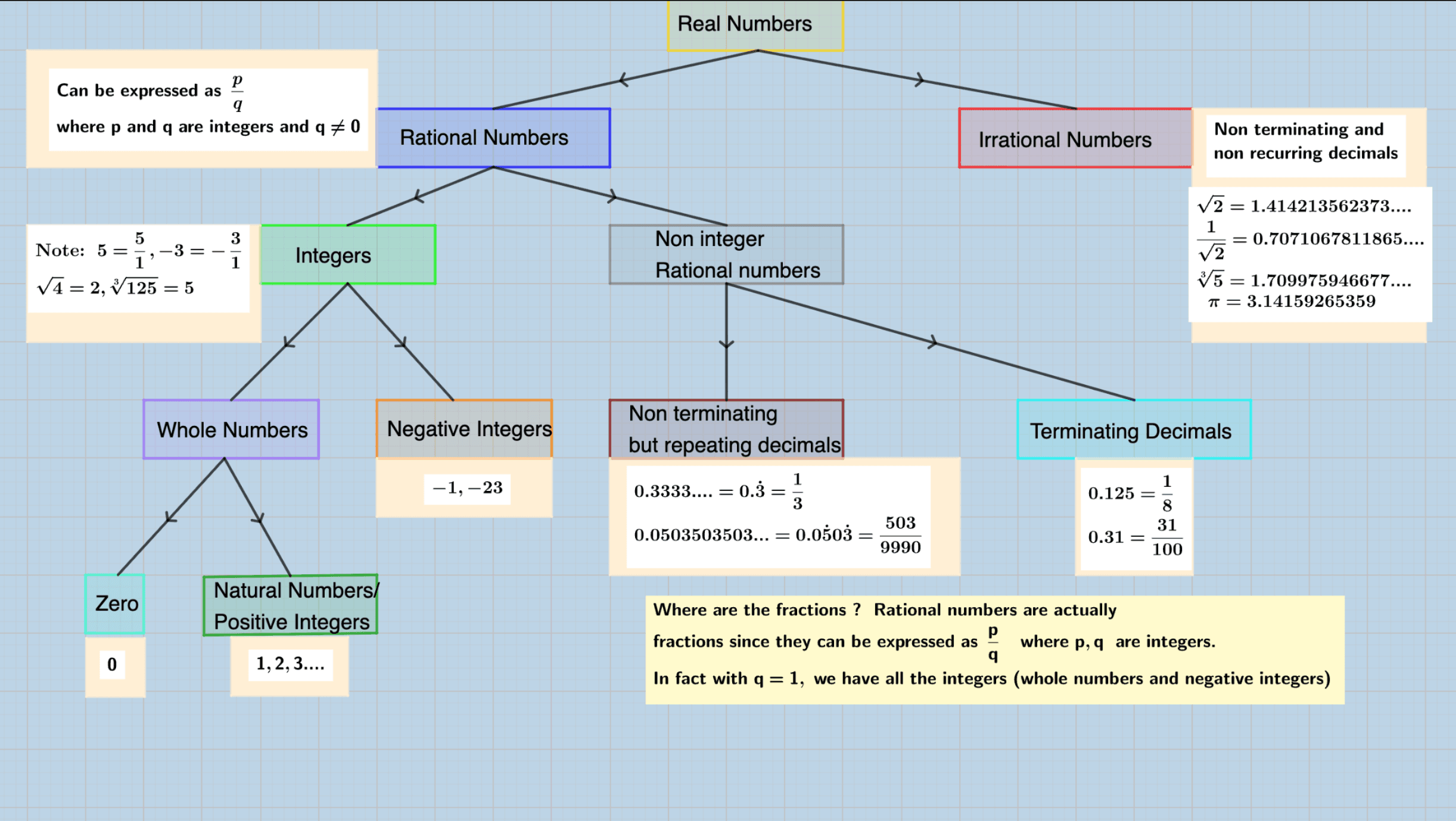
- Natural Numbers – They are the counting numbers starting from 1. Examples are 1, 2, 3, 4, 5 and so on
- Whole Numbers – Whole numbers include 0 and all natural numbers
- Integers – They are whole numbers and negative of natural numbers, example, …-3, -2, -1, 0, 1, 2, 3,….
- Rational Numbers – They are numbers which can be represented in p/q form where p and q are integers and q is not equal to 0. Example is 3/4
- Irrational Numbers – Numbers which are not rational are irrational numbers
- Real Numbers – Includes all numbers which can be represented on number line
- Complex Numbers – A complex number is written in the form: z = a + bi , Where:
- a = Real part denoted by Re z
- b = Imaginary part denoted by Im z
- i = Imaginary unit
- Even and Odd Numbers – Numbers that are divisible by 2 are called even numbers. Numbers that are not divisible by 2 are called odd numbers.
- Prime and Composite Numbers – A prime number is a natural number greater than 1 that has exactly two distinct factors, a composite number is a natural number greater than 1 that has more than two factors.
Operations on Numbers
Operations on numbers are mathematical processes used to combine, compare, or change numbers to obtain a result. These operations help us perform calculations and solve mathematical problems in everyday life and advanced mathematics.
The four basic operations on numbers are:
Numbers on Number Line
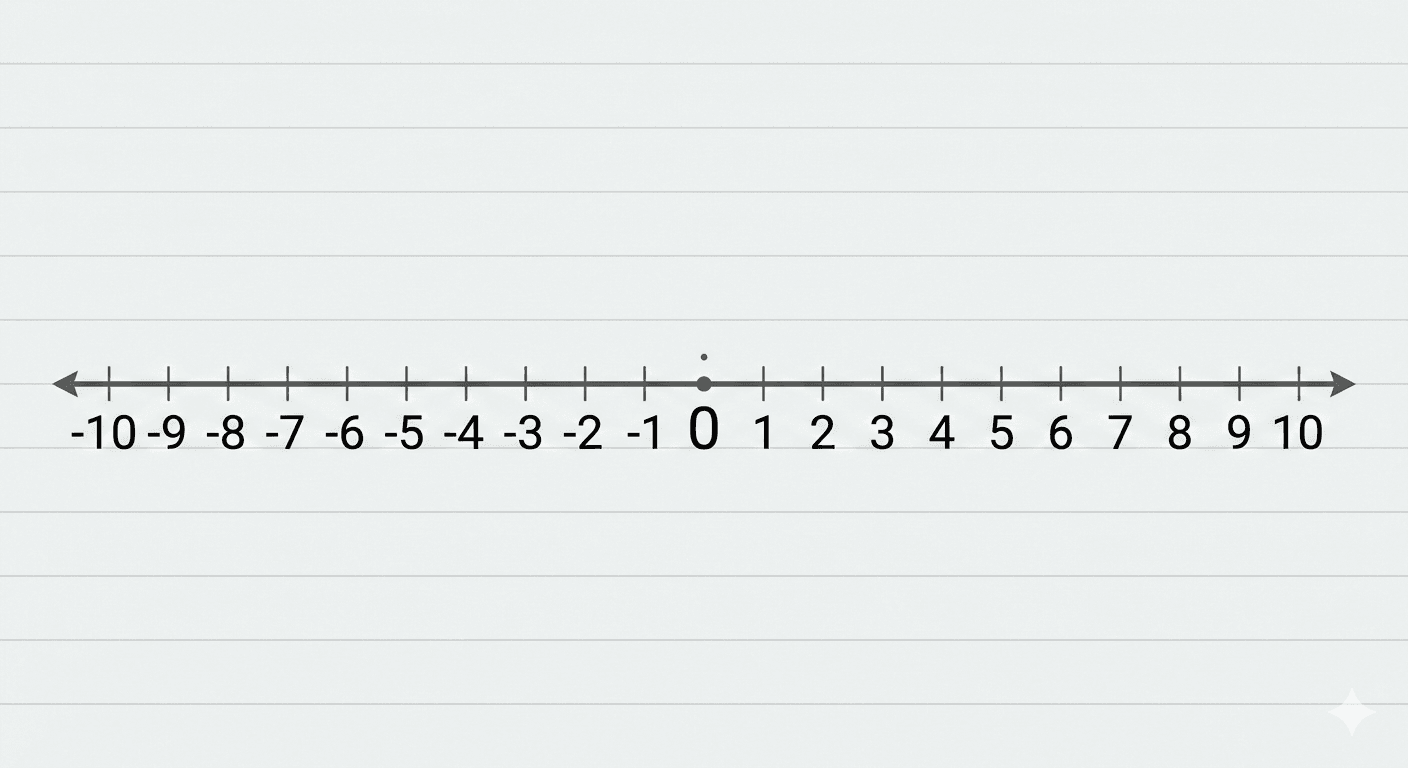
A number line is a straight horizontal line used to represent numbers visually. Each point on the line corresponds to a specific number. The number line helps students understand the position, order, and relationship between numbers.
The number 0 is usually placed at the center of the number line and is called the origin.
- Numbers to the right of 0 are positive numbers.
- Numbers to the left of 0 are negative numbers.
- The number line extends infinitely in both directions.
Properties of Numbers
Numbers follow certain mathematical rules called properties. These properties make calculations easier and help us solve mathematical expressions correctly.
Some important properties of numbers are explained below.
- Commutative Property : The commutative property states that the order of numbers does not affect the result of addition or multiplication.
For addition : a+b=b+a
3+5=5+3=8
For multiplication : a × b = b × a
4 × 6 = 6 × 4 = 24
However, the commutative property does not apply to subtraction or division.
5 − 3 ≠ 3 − 5
2. Associative Property
The associative property states that when adding or multiplying three or more numbers, the grouping of numbers does not change the result.
For addition : (a + b) + c = a + (b + c)
(2 + 3) + 4 = 2 + (3 + 4)
5 + 4 = 2 + 7
9 = 9
For multiplication : (a × b) × c = a × (b × c)
(2 × 3) × 4 = 2 × (3 × 4)
6 × 4 = 2 × 12
24 = 24
3. The distributive property connects multiplication and addition.
It states that multiplying a number by a sum is the same as multiplying the number by each term separately.
a(b + c) = ab + ac
3(4 + 2) = 3×4 + 3×2
3(6) = 12 + 6
18 = 18
4. Identity Property : The identity property states that certain numbers do not change the value of another number when used in an operation.
a) Additive Identity : Zero is the additive identity.
a + 0 = a
7 + 0 = 7
b) Multiplicative Identity
One is the multiplicative identity.
a × 1 = a
9 × 1 = 9
5. Closure Property
The closure property states that performing an operation on numbers of a set gives a result that is also within the same set.
Example for integers:
3+5=8
Since 8 is also an integer, integers are closed under addition.
Number Systems in Computers
A number system is a method of representing numbers using digits and a specific base (also called radix). The base determines how many unique digits are used and the place value of each digit
Different number systems are:
- Decimal Number System
- Binary Number System
- Octal Number System
- Hexadecimal Number System