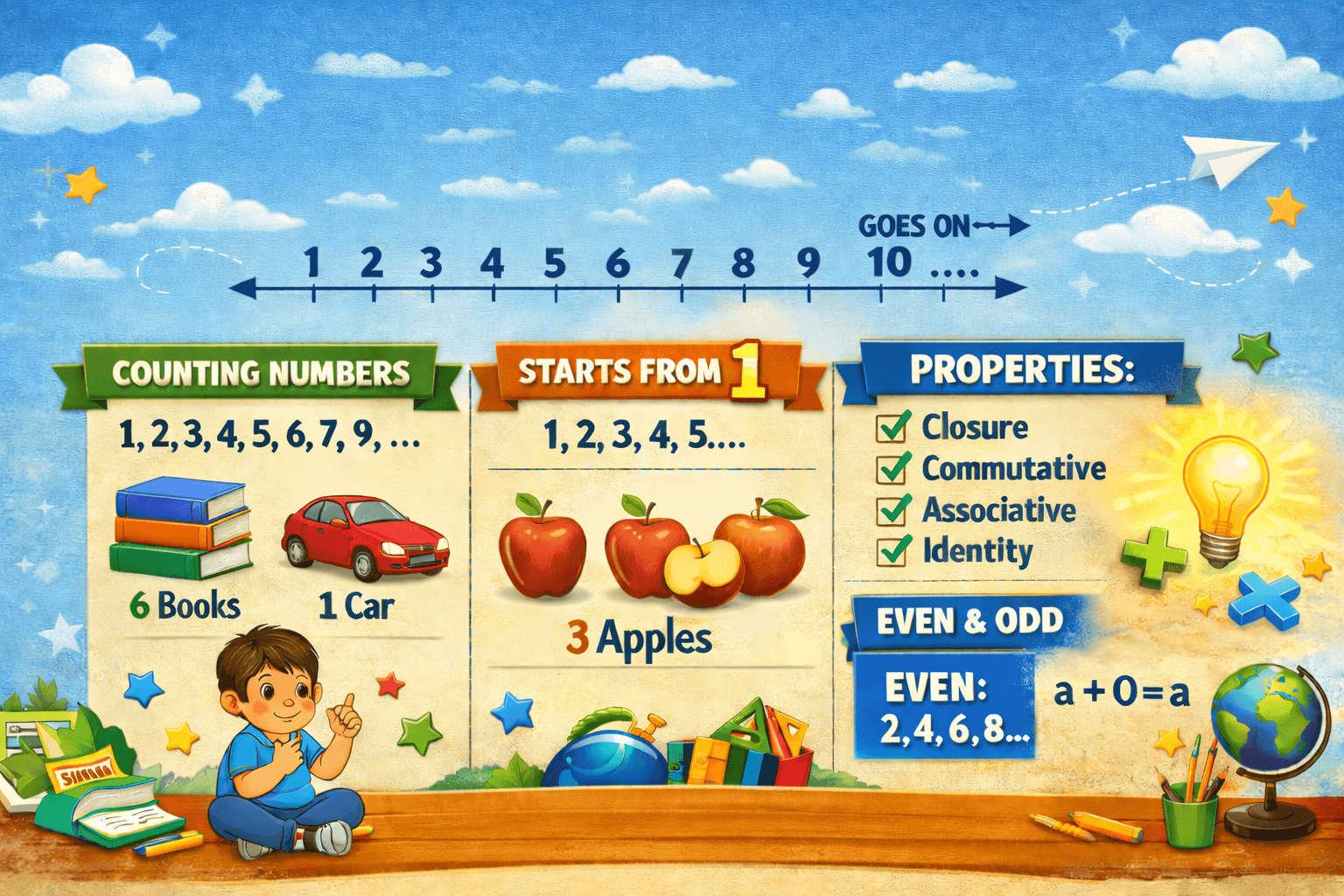

What are Natural Numbers?
- Natural numbers are the counting numbers starting from 1 and going up to infinity.
- N = {1, 2, 3, 4, 5, 6, 7, 8, 9, 10, …}
Importance of Natural Numbers
Natural numbers are important because:
- They are the first numbers we learn 😀
- Used in daily life for counting
- Form the base of arithmetic
- Essential for higher mathematics
Without natural numbers, mathematics cannot begin.
Even and Odd Natural Numbers
Natural numbers are divided into:
Even Numbers
Numbers divisible by 2
Examples: 2, 4, 6, 8, 10…
Odd Numbers
Numbers not divisible by 2
Examples: 1, 3, 5, 7, 9…
Difference Between Natural and Whole Numbers
| Natural Numbers | Whole Numbers |
|---|---|
| Start from 1 | Start from 0 |
| 1, 2, 3, 4… | 0, 1, 2, 3 |
So, all natural numbers are whole numbers, but not all whole numbers are natural numbers.
Properties of Natural Numbers
Natural numbers follow some important properties:
1. Closure Property : A set of numbers is closed under an operation if performing that operation on numbers in the set gives a result that is also in the same set.
- Addition Closure property : When we add two natural numbers, the result is always a natural number.
Example: 5 + 3 = 8 - Multiplication Closure property : When we multiply two natural numbers, the result is always natural.
Example: 4 × 6 = 24 - But subtraction is not always closed. Example: 3 − 5 = −2 (not a natural number)
- Subtraction and Division may not result in a natural number.
2. Commutative Property : If changing the order of numbers does not change the result, the operation is commutative.
- Commutative Property of Addition : Order of numbers does not change the sum : 4 + 7 = 7 + 4
- Subtraction is not commutative
- Commutative Property of Multiplication : Order of numbers does not change the product : 3 × 5 = 5 × 3
Order does not matter.
3. Associative Property
If changing the grouping of numbers does not change the result, the operation is associative. Grouping does not matter.
- Associative Property of Addition : Grouping the numbers does not change the sum : (2 + 3) + 4 = 2 + (3 + 4)
- Associative Property of Multiplication : Grouping the numbers does not change the product : (2 × 3) × 4 = 2 × (3 × 4)
Associative Property does not hold true for subtraction and division.
4. Distributive Property
- Distributing Multiplication over Addition : a(b + c) = ab + ac
- Distributing multiplication over subtraction : a(b – c) = ab – ac
5. Identity Property : An identity element is a number which, when used in an operation, does not change the original number. Number stays the same.
- Additive identity: 0 (a + 0 = a)
- Multiplicative identity: 1 (a × 1 = a)