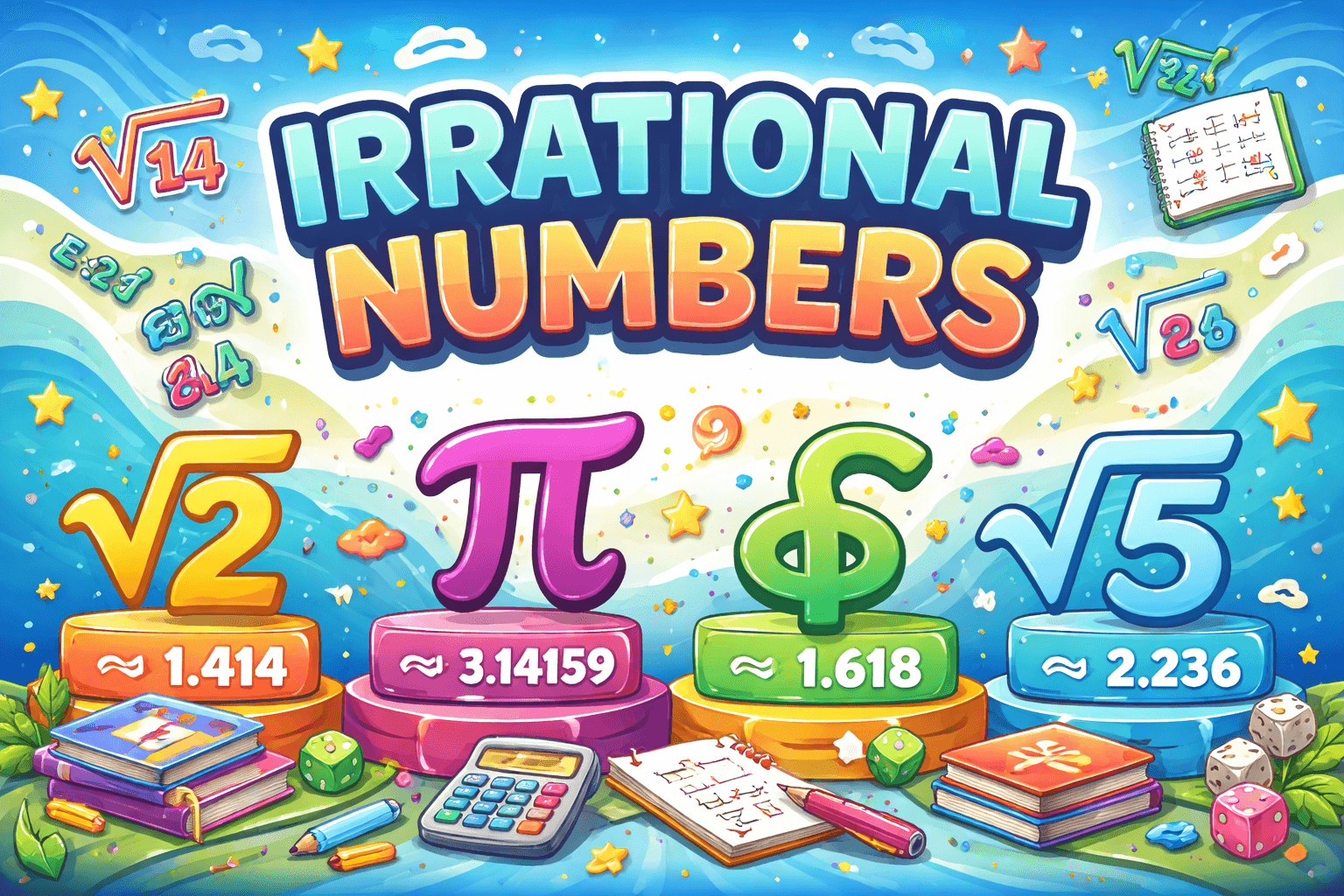

What are Irrational Numbers?
Irrational numbers are numbers that cannot be expressed as a ratio of two integers and whose decimal expansion is non-terminating and non-repeating or we can say the decimal representation of irrational numbers has infinite digits that never repeat in a pattern.
Irrational numbers examples include:
- √2 = 1.41421356… (non-terminating, non-repeating)
- √3 = 1.73205081…
- π (Pi) = 3.14159265…
- e (Euler’s number) = 2.71828…
- φ (Golden Ratio) = 1.618…
These numbers appear frequently in geometry, algebra, trigonometry, and real-world measurements.
Understanding irrational numbers is essential for students studying number systems in mathematics.
History of Irrational Numbers
The concept of irrational numbers was discovered by ancient Greek mathematicians. According to historical accounts, the mathematician Hippasus discovered that √2 cannot be expressed as a fraction.
This discovery came from studying a square with side length 1. The diagonal of such a square has length √2. When mathematicians tried to express √2 as a ratio of integers, they realized it was impossible. This led to the discovery of irrational numbers.
Decimal Representation of Irrational Numbers
The decimal form of irrational numbers has two main characteristics:
1. Non-terminating
The decimal expansion never ends.
Example:
2. Non-repeating
There is no repeating pattern in the digits.
Example:
This property distinguishes irrational numbers from rational numbers.
Difference Between Rational and Irrational Numbers
| Rational Numbers | Irrational Numbers |
|---|---|
| Can be written as p/q where p and q are integers and q is not equal to zero | Cannot be written as p/q |
| Decimal form is Terminating or repeating | Decimal form is Non-terminating and non-repeating |
| Fraction form is always possible | Fraction form is not possible |
Properties of Irrational Numbers
Irrational numbers have several interesting mathematical properties.
1. Sum with a Rational Number
Adding a rational number to an irrational number gives an irrational number.
Example:
This result is irrational.
2. Product with a Non-Zero Rational Number
Multiplying an irrational number by a non-zero rational number produces an irrational number.
Example:
This is irrational.
3. Sum of Two Irrational Numbers
Sometimes the result is irrational, but sometimes it can be rational.
Example:
Result is Irrational.
But:
Result is Rational.
Types of Irrational Numbers
Although all irrational numbers share the same basic property, they can be grouped into different types.
1. Square Root Irrational Numbers
These arise when we take the square root of numbers that are not perfect squares.
Examples:
- √2
- √3
- √5
- √7
For instance,
Since the decimal expansion does not terminate or repeat, √2 is irrational.
However,
This is not irrational because 4 is a perfect square.
2. Cube Root Irrational Numbers
Cube roots of numbers that are not perfect cubes are irrational.
Examples:
- ∛2
- ∛5
- ∛7
Example:
The decimal expansion continues infinitely without repetition.
3. Transcendental Numbers
Some irrational numbers are called transcendental numbers. These numbers cannot be solutions of any polynomial equation with integer coefficients.
Famous examples include:
- π (Pi)
- e (Euler’s number)
Example:
Pi represents the ratio of a circle’s circumference to its diameter.
Irrational Numbers on Number Line
Have you ever wondered how to find the exact location of an irrational number like √2 or √5 on a flat number line? Since these decimals never end, we can’t just “guess” where they land. Instead, we use the Pythagorean Theorem and a bit of geometry.
Use the interactive tool below to visualize the step-by-step construction of these numbers using right-angled triangles and a compass arc.
Representing Irrational Numbers
Using the Pythagorean theorem to plot square roots.
Step 0: Choose a number and click ‘Next Step’