
What Are Numbers in Maths?
Numbers are the basic building blocks of mathematics used to represent quantity, value, and position of something. They help us count objects, measure distances, compare quantities, and perform calculations. Numbers are used in everyday life, such as counting money, telling time, and measuring length.
For example:
- If you have 5 apples, the number 5 represents the quantity of apples.
- If a road is 10 km long, the number 10 represents the measurement.
Numbers make it possible to describe the world in a precise and structured way.
History of Numbers
The concept of numbers developed thousands of years ago when humans needed a way to count objects such as animals, tools, and food supplies.
Early civilizations used simple counting systems. Some important developments in the history of numbers include:
- Ancient Egyptians used symbols to represent numbers.
- Babylonians developed one of the earliest number systems.
- Roman numerals were used in ancient Rome.
- Indian mathematicians developed the modern decimal number system and introduced the concept of zero.
The modern number system used today is called the Hindu-Arabic numeral system, which includes digits from 0 to 9.
Numbers Types
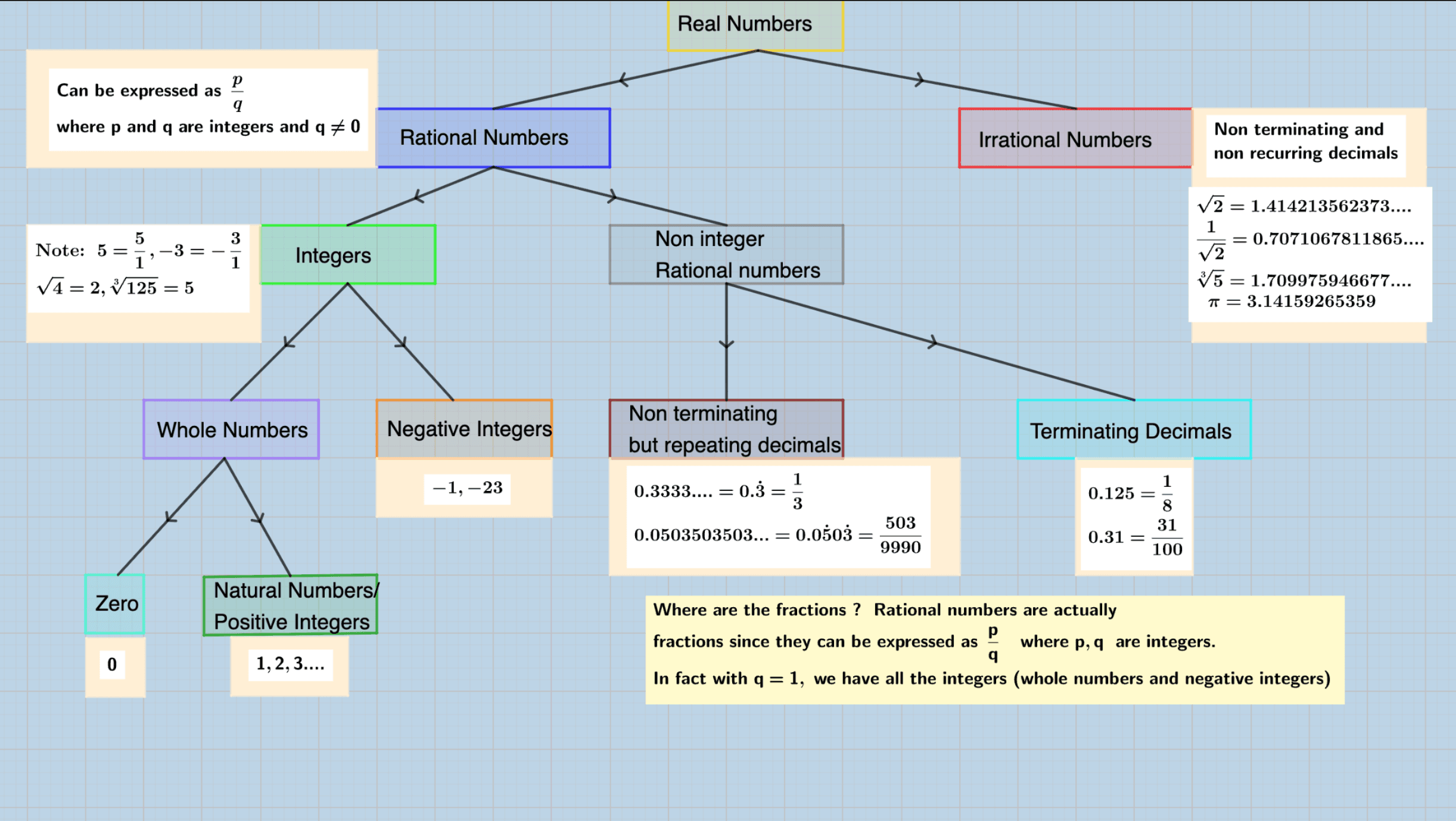
Numbers are divided into different types based on their properties and how they are used.
Operations on Numbers
Operations on numbers are mathematical processes used to combine, compare, or change numbers to obtain a result. These operations help us perform calculations and solve mathematical problems in everyday life and advanced mathematics.
The four basic operations on numbers are:
- Addition
- Subtraction
- Multiplication
- Division
Numbers on Number Line
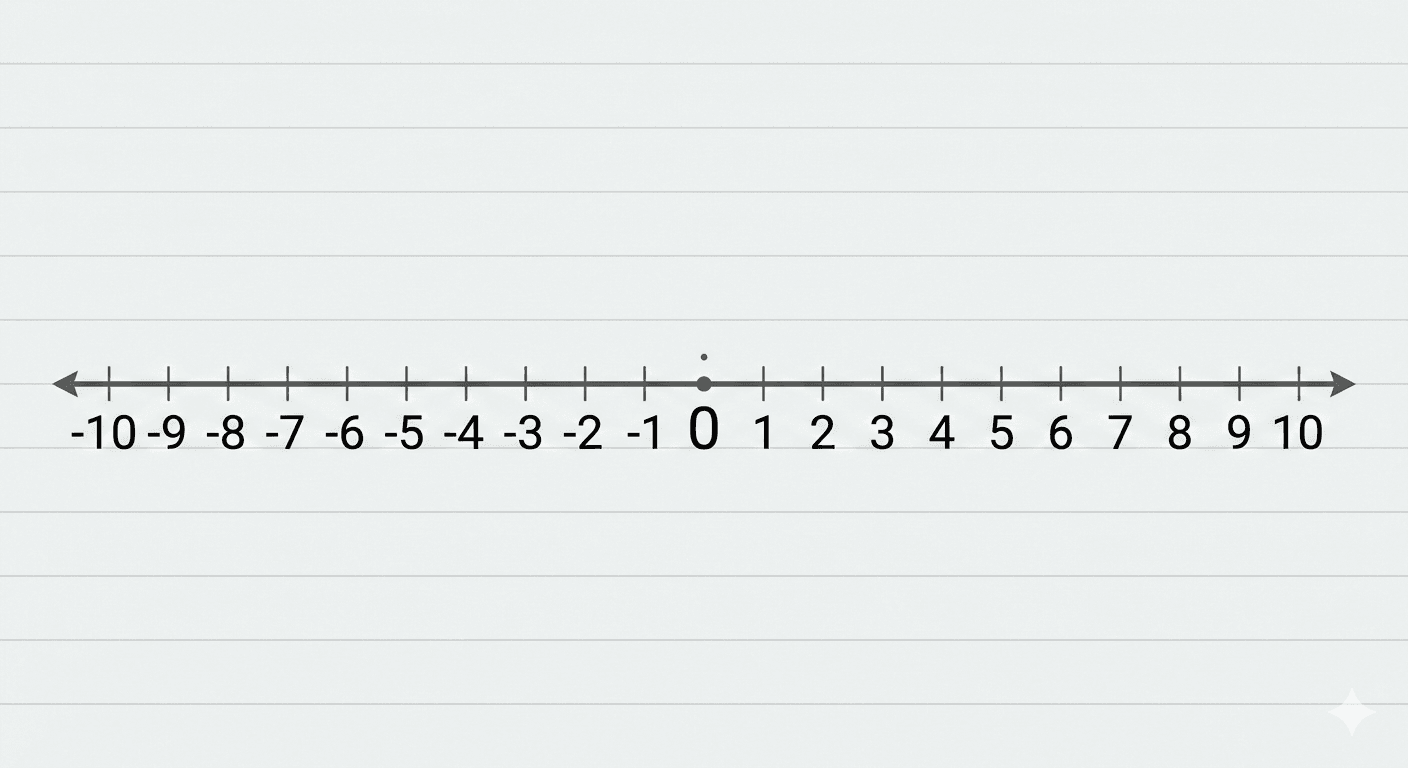
A number line is a straight horizontal line used to represent numbers visually. Each point on the line corresponds to a specific number. The number line helps students understand the position, order, and relationship between numbers.
The number 0 is usually placed at the center of the number line and is called the origin.
- Numbers to the right of 0 are positive numbers.
- Numbers to the left of 0 are negative numbers.
- The number line extends infinitely in both directions.
Properties of Numbers
Numbers follow certain mathematical rules called properties. These properties make calculations easier and help us solve mathematical expressions correctly.
Some important properties of numbers are explained below.
- Commutative Property : The commutative property states that the order of numbers does not affect the result of addition or multiplication.
For addition : a+b=b+a
3+5=5+3=8
For multiplication : a × b = b × a
4 × 6 = 6 × 4 = 24
However, the commutative property does not apply to subtraction or division.
5 − 3 ≠ 3 − 5
2. Associative Property
The associative property states that when adding or multiplying three or more numbers, the grouping of numbers does not change the result.
For addition : (a + b) + c = a + (b + c)
(2 + 3) + 4 = 2 + (3 + 4)
5 + 4 = 2 + 7
9 = 9
For multiplication : (a × b) × c = a × (b × c)
(2 × 3) × 4 = 2 × (3 × 4)
6 × 4 = 2 × 12
24 = 24
3. The distributive property connects multiplication and addition.
It states that multiplying a number by a sum is the same as multiplying the number by each term separately.
a(b + c) = ab + ac
3(4 + 2) = 3×4 + 3×2
3(6) = 12 + 6
18 = 18
4. Identity Property : The identity property states that certain numbers do not change the value of another number when used in an operation.
a) Additive Identity : Zero is the additive identity.
a + 0 = a
7 + 0 = 7
b) Multiplicative Identity
One is the multiplicative identity.
a × 1 = a
9 × 1 = 9
5. Closure Property
The closure property states that performing an operation on numbers of a set gives a result that is also within the same set.
Example for integers:
3+5=8
Since 8 is also an integer, integers are closed under addition.
Number Systems in Computers
A number system is a method of representing numbers using digits and a specific base (also called radix). The base determines how many unique digits are used and the place value of each digit
Different number systems are:
- Decimal Number System
- Binary Number System
- Octal Number System
- Hexadecimal Number System