
For centuries, mathematicians were stumped by a simple problem: What is the square root of a negative number? Since any number multiplied by itself (positive or negative) results in a positive value, the equation x2 = -1 seemed impossible.
Enter the Complex Number. Far from being “imaginary” in the sense of being fake, complex numbers are essential tools in modern physics, engineering, and computer graphics.
What is a Complex Number?
A complex number is written in the form:
z = a + bi
Where:
• a = Real part denoted by Re z
• b = Imaginary part denoted by Im z
• i = Imaginary unit
The imaginary unit is defined as:
i² = −1
Example:
3 + 4i
Real part = 3
Imaginary part = 4i
The Imaginary unit (i)
The imaginary unit allows us to represent the square root of −1.
i = √−1
Powers of i follow a repeating cycle:
i¹ = i
i² = −1
i³ = −i
i⁴ = 1
Then the pattern repeats:
i⁵ = i
i⁶ = −1
i⁷ = −i
i⁸ = 1
This cycle repeats every 4 powers.
In general, for any integer k:
i⁴ᵏ = 1
i⁴ᵏ⁺¹ = i
i⁴ᵏ⁺² = −1
i⁴ᵏ⁺³ = −i
Square Root of −1
We know that:
i² = −1
So the numbers whose square is −1 are:
i and −i
Therefore, the square roots of −1 are:
i , −i
However, by definition:
√−1 = i
The symbol √ represents the principal (standard) root.
Square Root of Other Negative Numbers
Example:
√−3
Write −3 as:
−3 = 3 × (−1)
So:
√−3 = √3 × √−1
√−3 = √3 i
Thus, the two square roots of −3 are:
± √3 i
But:
√−3 = √3 i
represents only the principal root.
General Formula
If a is a positive real number, then:
√−a = √a i
Examples:
√−7 = √7 i
√−25 = 5i
Important Property of Square Roots
For positive real numbers:
√a × √b = √ab
Example:
√2 × √3 = √6
Important Warning (When Numbers are Negative)
The property:
√a × √b = √ab
does NOT work when both a and b are negative.
Example:
If we apply the rule incorrectly:
√−1 × √−1 = √1 = 1
But actually:
i × i = i² = −1
So:
1 ≠ −1
This is a contradiction.
Final Conclusions
- Square roots of negative numbers are expressed using i.
- For any positive real number a:
√−a = √a i - The rule:
√a √b = √ab
is not valid when both a and b are negative.
The Modulus and the Conjugate of a Complex Number
Let z = a + ib be a complex number. Then the modulus of z, denoted by |z|, is defined as:
|z| = √(a² + b²)
The conjugate of z, denoted by z, is defined as:
z = a − ib
Examples
|3 + i| = √(3² + 1²) = √10
|2 − 5i| = √(2² + (−5)²) = √29
3 + i = 3 − i
2 − 5i = 2 + 5i
−3i − 5 = 3i − 5
Multiplicative Inverse
The multiplicative inverse of a non-zero complex number z is:
z−1 = 1 / (a + ib)
= a/(a² + b²) − i·b/(a² + b²)
= (a − ib)/(a² + b²)
= z / |z|²
Important Result
z × z = |z|²
Properties
For any two complex numbers z₁ and z₂:
- |z₁ z₂| = |z₁| |z₂|
- |z₁ / z₂| = |z₁| / |z₂| (provided z₂ ≠ 0)
- z₁ z₂ = z₁ z₂
- z₁ ± z₂ = z₁ ± z₂
- z₁ / z₂ = z₁ / z₂ (provided z₂ ≠ 0)
Types of Complex Numbers
A complex number is generally written in the form:
z = a + bi
Based on the values of a and b, complex numbers are classified into different types:
General Complex Number
A number of the form a + ib, where both real and imaginary parts may be non-zero.
Examples:
- 3 + 2i
- −5 + i
- 4 − 7i
Every complex number belongs to this category.
Purely Real Complex Number
If the imaginary part is zero (b = 0), the complex number becomes a real number.
Examples:
- 5 = 5 + 0i
- −3 = −3 + 0i
- 0 = 0 + 0i
Thus, every real number is also a complex number.
Purely Imaginary Complex Number
If the real part is zero (a = 0), the number is called purely imaginary.
Examples:
- 2i
- −5i
- i
- −0.6i
These numbers lie on the imaginary axis of the complex plane.
Zero Complex Number
If both real and imaginary parts are zero:
Example:
- 0
It is a special complex number that is both purely real and purely imaginary.
Non-Real Complex Number
If the imaginary part is not zero (b ≠ 0), the complex number is called non-real.
Examples:
- 3 + 2i
- −1 − 4i
- 6 + 0.5i
These numbers cannot be represented on the real number line.
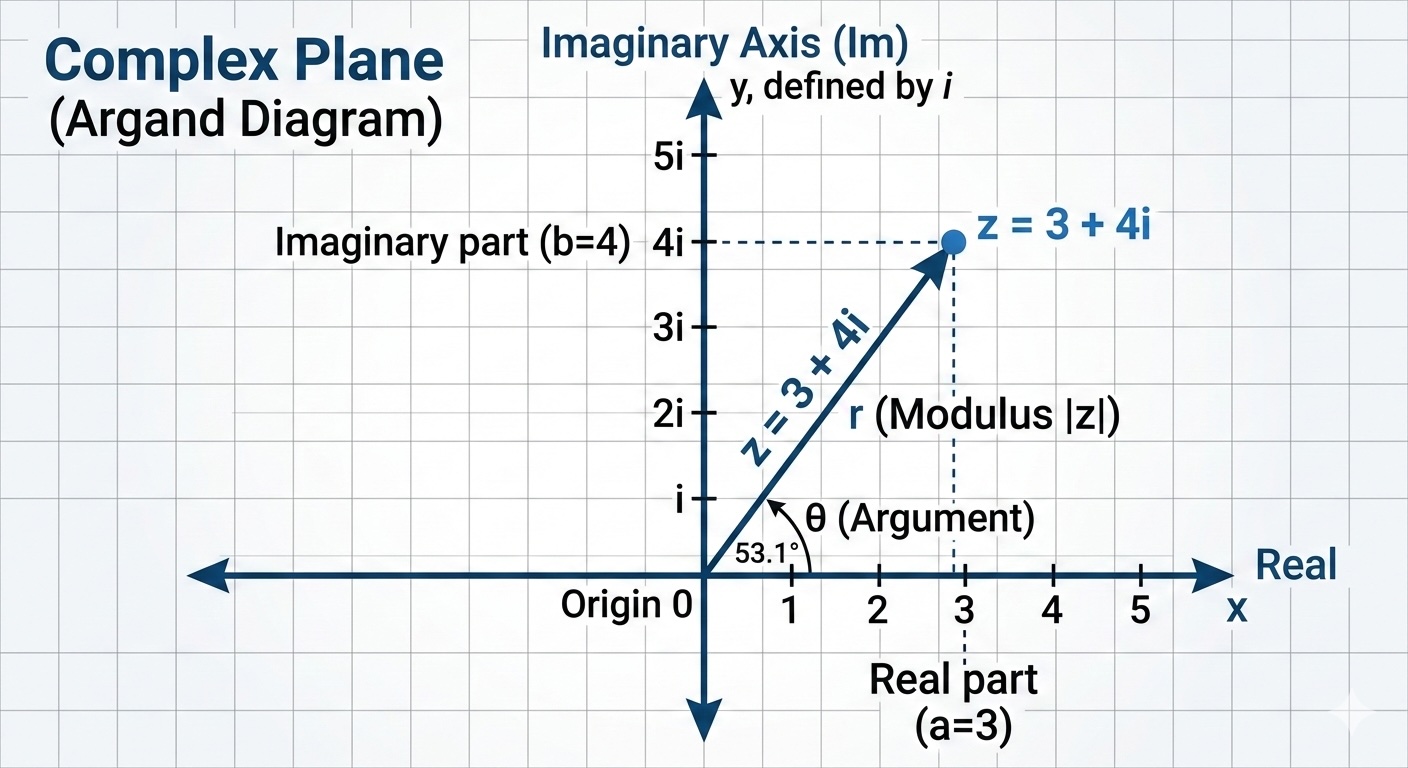
Visualising the Complex Plane or Argand Plane
Unlike real numbers, which sit on a single line, complex numbers require two dimensions. We use the Complex Plane (Argand Diagram):
- Horizontal Axis (x): The Real part (a).
- Vertical Axis (y): The Imaginary part (bi).
Example: 3 + 4i is plotted 3 units right and 4 units up.
The plane having a complex number assigned to each of its point is called the complex plane or the Argand plane
Complex Roots of Quadratic Equations
A quadratic equation is an equation of degree 2:
ax2+bx+c=0
where a ≠ 0
The solutions (roots) of this equation are found using the quadratic formula:
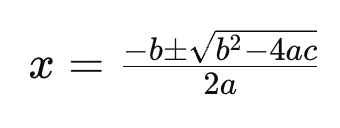
The expression inside the square root is called the discriminant:
The nature of roots depends on the value of D:
Case 1: D > 0 → Two distinct real roots
Example:
x² − 5x + 6 = 0
Roots:
x = 2, 3
Both roots are real numbers.
Case 2: D = 0 → Equal real roots
Example:
x² − 4x + 4 = 0
Root:
x = 2 (repeated)
Both roots are equal and real.
Case 3: D < 0 → Complex roots
When the discriminant is negative, the square root of a negative number appears.
Since:
√(-1) = i
complex numbers are used.
Example of Complex Roots
Solve:
x² + 4 = 0
Step 1:
x² = −4
Step 2:
Take square root
Step 3:
Use √(-1) = i
Roots are complex numbers.
Example using Quadratic Formula
Solve:
x² + 2x + 5 = 0
Here:
a = 1, b = 2, c = 5
Discriminant:
D = b² − 4ac
D = 2² − 4(1)(5)
D = 4 − 20
D = −16
Using formula:
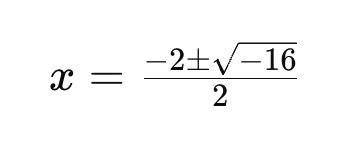
Simplify:
√(-16) = 4i
Roots are complex conjugates.
Important Result
If a quadratic equation has complex roots, they always occur in conjugate pairs:
Example:
-1 + 2i and -1 − 2i
The Argument (𝛳) in Complex Numbers
In the context of complex numbers, 𝛳(theta) represents the argument, often written mathematically as arg(z)
The argument is the angle formed between the positive Real axis (the right side of the horizontal line) and the line connecting the origin to your complex number.
When defining a point in the complex plane:
- The Modulus (r) tells you how far the point is from the center (origin).
- The Argument (𝛳) tells you which direction to point.
It is a crucial part of writing complex numbers in polar form. Instead of standard rectangular coordinates (a + bi), polar form looks like:
z = r(cos 𝛳 + i sin 𝛳)
z = r eiᶿ (Euler’s Formula)
To calculate 𝛳, basic trigonometry can be used based on the real part (a) and the imaginary part (b):
tan 𝛳 = b/a
For example, if z = 3+4i :
Real part (a) = 3
Imaginary part (b) = 4
tan 𝛳 = b/a = 4/3
𝛳 = 53.1°
Conjugate of Complex Number in Argand Plane
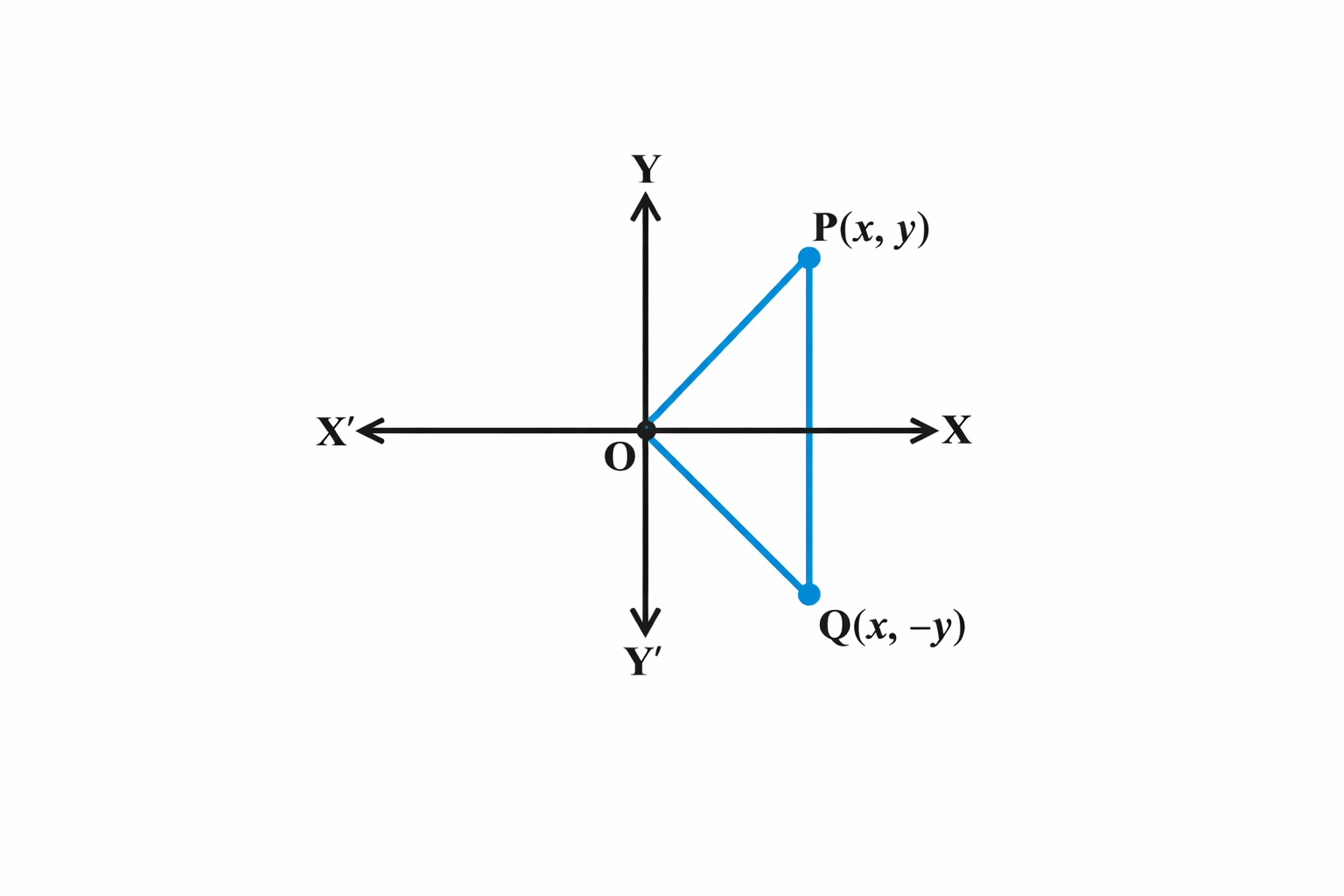
The representation of a complex number z = x + iy and its conjugate z = x – iy in the Argand plane are, respectively, the points P (x, y) and Q (x, – y). Geometrically, the point (x, – y) is the mirror image of the point (x, y) on the real
axis.
Algebra of Complex Numbers
In this section, we develop the algebra of complex numbers
- Addition of two complex numbers
Let
and
be any two complex numbers.
Then the sum of and is defined as
Thus, the sum of two complex numbers is again a complex number.
Example
Properties of Addition of Complex Numbers
The addition of complex numbers satisfies the following properties:
(i) Closure Law
The sum of two complex numbers is always a complex number.
is a complex number for all complex numbers and
(ii) Commutative Law
For any two complex numbers and ,
(iii) Associative Law
For any three complex numbers
(iv) Existence of Additive Identity
There exists a complex number
denoted simply as 0, called the additive identity or zero complex number, such that
for every complex number .
(v) Existence of Additive Inverse
For every complex number
there exists a complex number
denoted by
This number is called the additive inverse (or negative) of
Thus,z+(−z)=0
which gives the additive identity.
2. Subtraction of Two Complex Numbers:
Given any two complex numbers z₁ and z₂ , the difference z₁ − z₂ is defined as:
z₁ − z₂ = z₁ + (−z₂)
Examples
Example 1
(6 + 3i) − (2 − i)
= (6 + 3i) + (−2 + i)
= 4 + 4i
Example 2
(2 − i) − (6 + 3i)
= (2 − i) + (−6 − 3i)
= −4 − 4i
3. Multiplication of Two Complex Numbers
Let
z₁ = a + ib
z₂ = c + id
be any two complex numbers.
The product z₁z₂ is defined as:
z₁z₂ = (ac − bd) + i(ad + bc)
Example:
(3 + i5)(2 + i6)
= (3 × 2 − 5 × 6) + i(3 × 6 + 5 × 2)
= −24 + i28
Properties of Multiplication of Complex Numbers
1. Closure Law
The product of two complex numbers is also a complex number.
If z₁ and z₂ are complex numbers, then
z₁z₂ is also a complex number.
2. Commutative Law
For any two complex numbers z₁ and z₂:
z₁z₂ = z₂z₁
3. Associative Law
For any three complex numbers z₁, z₂, z₃:
(z₁z₂)z₃ = z₁(z₂z₃)
4. Multiplicative Identity
There exists a complex number
1 + 0i (denoted as 1)
such that for every complex number z:
z × 1 = z
5. Multiplicative Inverse
For every non-zero complex number
z = a + ib (where a ≠ 0 or b ≠ 0)
there exists a complex number:
1/z = a/(a² + b²) − i b/(a² + b²)
This number is called the multiplicative inverse of z.
It satisfies:
z × (1/z) = 1
6. Distributive Law
For any three complex numbers z₁, z₂, z₃:
(a) z₁(z₂ + z₃) = z₁z₂ + z₁z₃
(b) (z₁ + z₂)z₃ = z₁z₃ + z₂z₃
4. Division of Two Complex Numbers:
Given any two complex numbers and , where , the quotient is defined by
Example
Let
Step 1: Write the Division
Step 2: Find the Multiplicative Inverse of the Denominator
Step 3: Multiply
Step 4: Expand
Step 5: Final Answer
or
5. Identities of Complex Numbers
The following identities are true for all complex numbers z₁ and z₂.
(z₁ + z₂)² = z₁² + z₂² + 2z₁z₂
(z₁ − z₂)² = z₁² − 2z₁z₂ + z₂²
(z₁ + z₂)³ = z₁³ + 3z₁²z₂ + 3z₁z₂² + z₂³
(z₁ − z₂)³ = z₁³ − 3z₁²z₂ + 3z₁z₂² − z₂³
z₁² − z₂² = (z₁ + z₂)(z₁ − z₂)
These identities are similar to algebraic identities for real numbers and are also valid for complex numbers.
Complex numbers follow distributive law, commutative law and associative law.
Equality of Complex Numbers
Two complex numbers are equal if their real parts and imaginary parts are equal.
If
then
Why Do They Matter?
It’s easy to think these are theoretical, but they drive our modern world:
- Electrical Engineering: Essential for calculating AC circuits and impedance.
- Fluid Dynamics: Used to model airflow over airplane wings.
- Quantum Physics: The Schrödinger equation relies on complex numbers.
- Fractals: The Mandelbrot Set is generated through iterations of complex numbers.